
A reading
The Shtender
An essay by Jack Love
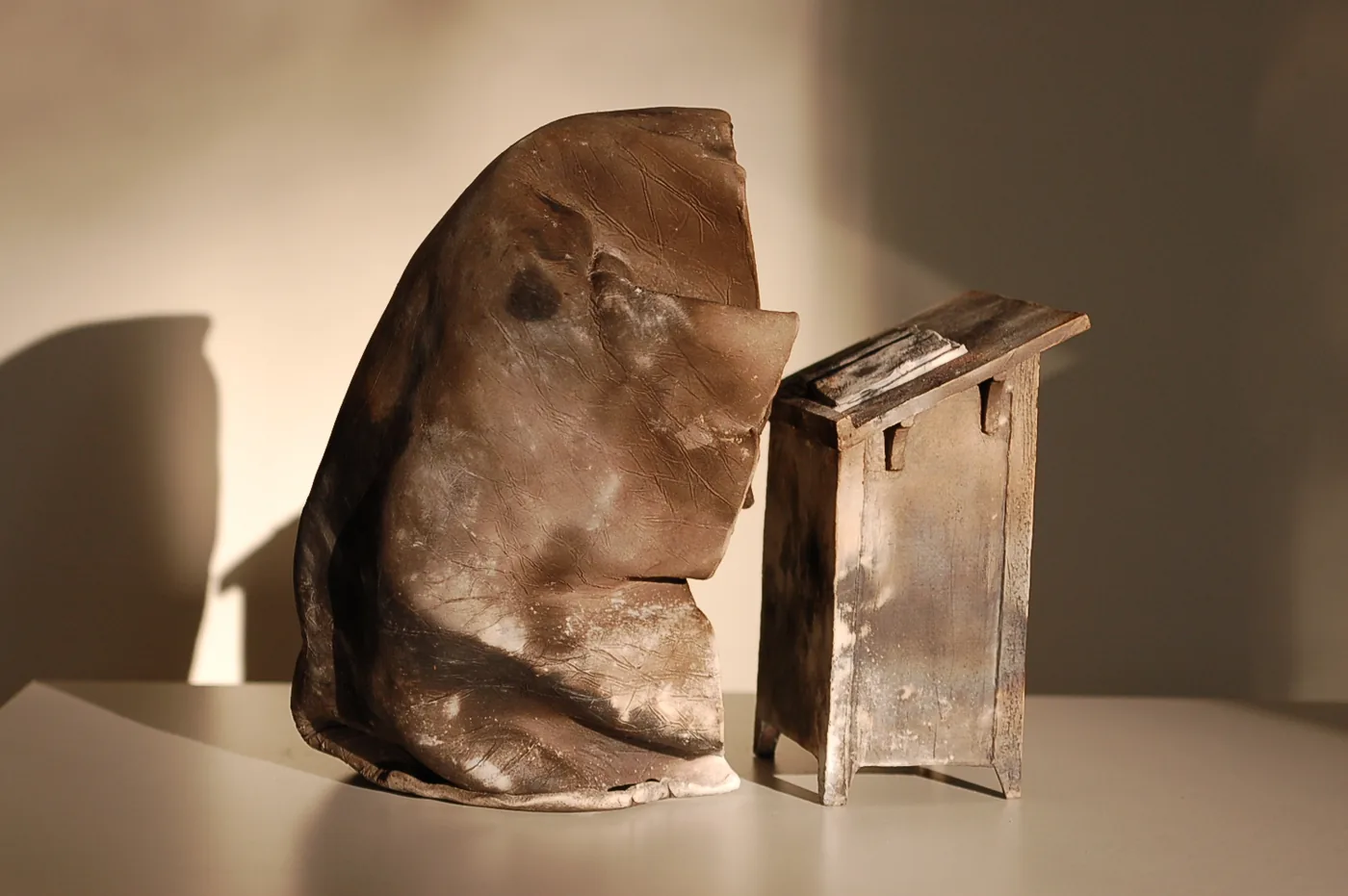
Jack Love, a historian of the Jewish Mediterranean, posted this on his family's blog the week the Schwarzbart Gallery opened at the Arnstein Jewish Community Center in Knoxville. It is the one piece of writing on The Shtender by someone who grew up in the world the sculpture remembers. The passages about the piece are given here; the full post, which also takes in the author's course readings and a digression on medieval Jewish symbolism, is in the PDF.
The original post (PDF, 2 pages)
I would like to start a conversation about a piece of visual art. The piece is a small sculpture created by a long-time, recently deceased Knoxville resident, Mr. Arnold Schwarzbart. On Sunday, the Knoxville Jewish Community will be inaugurating a new wing of their facility, an art gallery named in honor of Schwarzbart.
…
At first glance, this piece might look interesting or quaint to most people. At this point in time, most American Jews probably would lack any sense of its meaning. But Arnold was born and bred in the culture of the East European shtetl (Jewish community or ghetto), and to anyone who understands that culture, the figure is instantly knowable and arresting. It is the figure of a man (and this was a male role in that culture) studying a holy book. We know this because he is wrapped in a large talit, or prayer shawl, which covers his head and a large part of his body. He is standing at a tall table or lectern upon which a book would have been laid. In many shtetl synagogues, the man would have been joined by other men standing around the lectern studying with him.
Even more arresting is the fact that the man is not actually in the sculpture at all. Like a ghost, his physical existence is suggested only by the shape of the shawl. When pressed, Arnold explained that the reason he showed the man in this way is because the man under the shawl had been turned into ashes. He no longer walked the earth.
When do we remember? I can’t say when Arnold Schwarzbart remembered a figure such as this. Perhaps he never saw the person himself–after all, he was but a child when he was taken to the camps.1 The first time I can recall seeing this was not, oddly enough, during my youth in the Jewish part of the Bronx. Rather, it was when I was already done with college and had headed off to Israel for a year abroad, a gap year before I would start graduate school.
I was in a place called the “WUJS Institute” located at that time in Arad, some 7 km from the Dead Sea. The institute employed a man who had arrived in Israel from his native Poland. One of the small number who had somehow escaped the Holocaust and subsequently the Communist attempt to erase ethnic memory. He was a deeply pious man who worked hard all day and then at its end retreated to the synagogue where he studied. When I saw Schwarzbart’s figure, it was this man (whose name I never learned) who I saw.
The figure is probably evocative for a number of reasons to different people who may be members of different groups, but Eastern European Jews could not escape its authorial intent, and not even the women who, after all, had much less experience with study in the synagogue. I wonder how many people would pick up on the notion of the absence of a figure under the canopy.
Jack Love
Note
- Arnold was not in a camp. His family fled Tarnopol for the Soviet interior, where he was born in 1942, and the author says as much earlier in the post, where he calls Arnold a survivor "using the broad definition of the term." See About Arnold. ↩
Excerpted from the author's post of January 28, 2016, on the Jewish Interest page of his family's blog; the passages given here are the ones about the piece, and an ellipsis marks where text was left out. Text © Jack Love. Photograph © Arnold Schwarzbart and family.