
Arnold Schwarzbart ז״ל
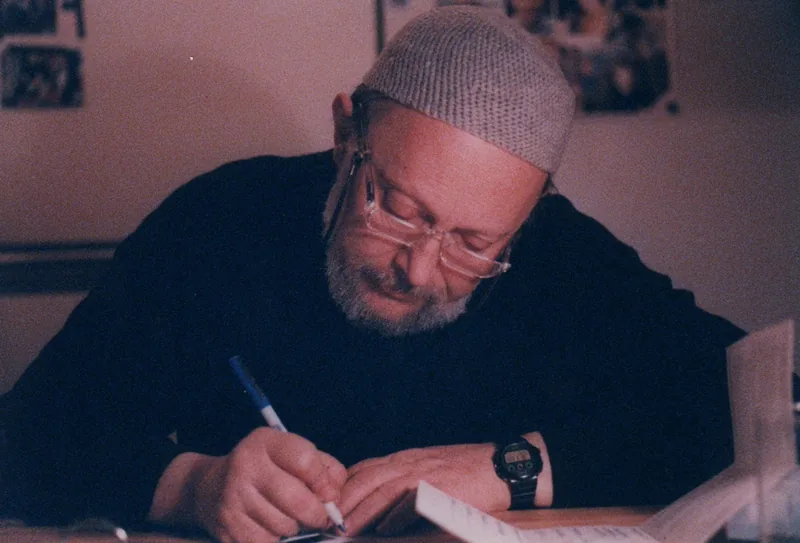
Arnold Schwarzbart was an architect who spent the last thirty-five years of his life making Judaica. He was born on March 10, 1942, and died on March 16, 2015, at home in Knoxville, Tennessee.
Early life
The Schwarzbart family came from Tarnopol, in what is now Ukraine, and his father's side from Tarnów in Poland. When the war reached them, Arnold's mother fled east with her father, and Arnold was born in Yaroslavl, Russia, in 1942. Three of his four grandparents were killed in the Holocaust, among them his grandmother Blima Schwarzbart. After the war the family settled in Vienna, where Arnold began school.
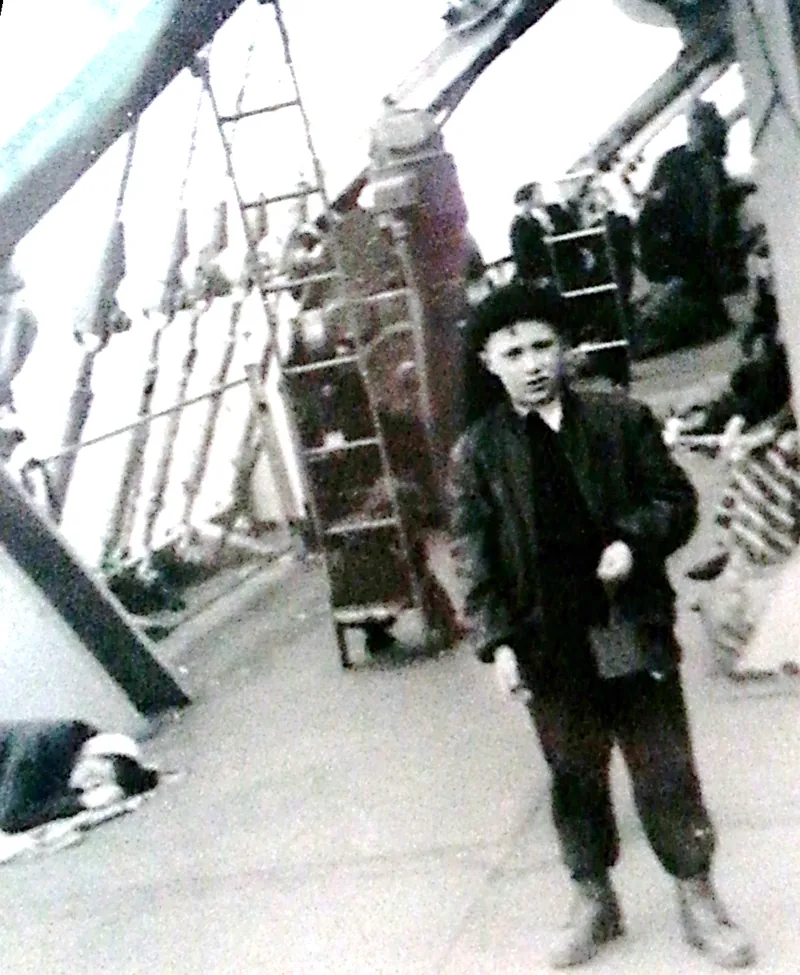
In 1951 Austria ordered foreign-born Jews to leave. A cousin of Arnold's grandfather, Max Friedman, a jeweler and city councilman in Knoxville, agreed to sponsor the family. They sailed from Bremerhaven on a converted troop ship and landed in New Orleans that April. Arnold was nine years old and spoke no English; he learned it at Flenniken Elementary School in South Knoxville, taught by a Mrs. Stewart. His father, Isadore, a tailor, spent the next twenty-five years with the Knoxville clothier John H. Daniel. His mother was Frieda Gruenberg Schwarzbart.
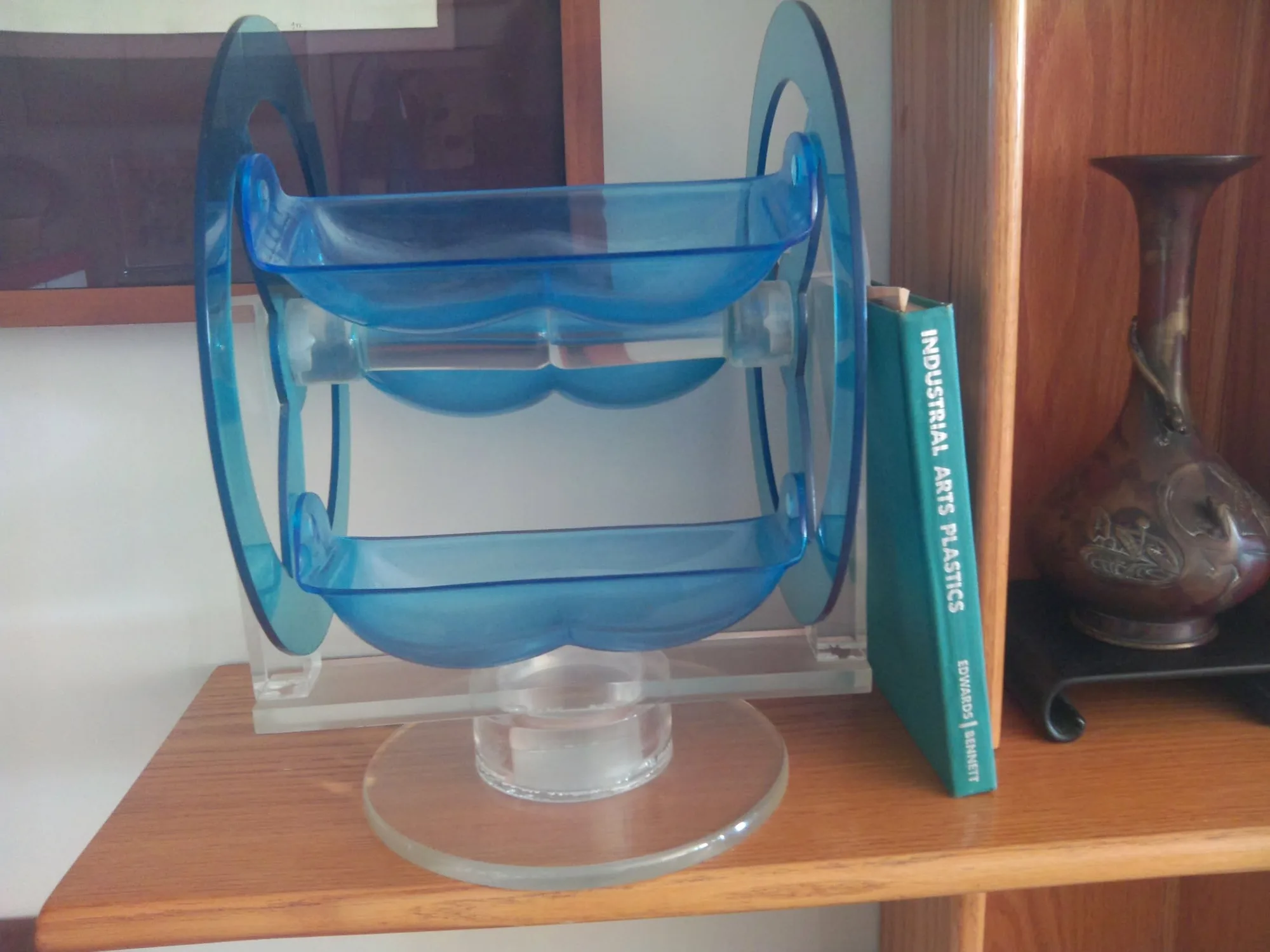
One of the earliest things he made still survives, a school project. At Park Junior High School he took shop with Lauton Edwards, who wrote textbooks on working plastics, and in the ninth grade he built a two-tier lazy susan in blue and clear Plexiglas, which took second place for its grade level in a national plastics competition. It was made in Knoxville at the Rohm and Haas plant on Dale Avenue, where the material itself was manufactured. The photographs and drawings for the piece are in Edwards's textbook Industrial Arts Plastics, published in 1964; his son, Mike Edwards, pointed the family to it. The lazy susan and the book are designated for the Arnold Schwarzbart Collection at the McClung Historical Collection.
The family joined Heska Amuna Synagogue, where Arnold became bar mitzvah and was confirmed, and which he would later lead as president. He graduated from East High School. At the Jewish Community Center he met Mary Linda; they married and were together for fifty-one years. Betty Bean told the family's story in a 2021 column for Knox TN Today, "History is the things we must never forget."
In his words
In Judaism we have the concept hiddur mitzvah, "The Beauty of Holiness." The idea is to make physically beautiful the objects and spaces used in the performance of ritual. At one level, that is the essence of my work. Trained as an architect, function often serves as my frame of reference. Another focus is the history of particular objects as expressed for millennia. For me, it is important that my work be connected to, and part of, the tradition of Jewish religious objects.
At the simplest level, beauty enhances the emotional component of any act, and is especially beneficial in encouraging activities that are repeated often. One looks forward to using a treasured item.
I grew up in a Jewish but totally non-observant home. Thirty years ago, I rediscovered Judaism and became enthusiastic about its practice and the very long history of ritual objects. Trained as an architect and designer, these objects had great fascination for me and after some time decided to pursue the making of ritual objects of my own design. Not to sound overly idealistic, but I felt that making such objects with a contemporary design hand would, for some people, create an emotional connection to their faith that would inspire connecting with the divine, and it is very rewarding when that happens.
In my most recent work I am attempting to get to the heart of spiritual awareness. These pieces aim to inspire God consciousness even more than religious practice.
The first two passages are from his artist statement and from the 2008 exhibition "Reflections of the Other" at the University of Tennessee. The third is from a grant application, quoted in Betty Bean's column "The house that Arnold built."
A poem he wrote in the late 1960s:
The work
The turn came with a dream. In the late 1970s, flying home from Chicago just before Rosh Hashanah, Arnold fell asleep and dreamed of an enormous fish drawing a man in a rowboat into its open mouth. He told Mary Linda about it when he landed; she had spent the week reading the Book of Jonah, which is read on Yom Kippur afternoon. The fish became his first New Year's card, and the card became a thirty-five year career in Judaica.
He did not like being called an artist. "He thought of himself as an artisan, plain and simple," Rabbi Mark Greenspan said at his funeral, "as a man who worked in clay and metal and ink, turning them into something both beautiful and useful."

From 1981 to about 1996 the studio made a line of ritual objects for the home: menorahs, kiddush cups, mezuzahs, Shabbat candlesticks and plates, seder plates, Elijah's cups, and tzedakah boxes, in white clay, by slip casting, slab building, and jiggering, sold through Judaica shops across the country. The first sale set the tone. Arnold asked Mary Linda where she would like the work sold; she named the gift shop of the Jewish Museum in New York, telephoned its buyer, and sold a dozen menorahs sight unseen. Those pieces, with the studio's own 1995 catalog descriptions, are in the Studio Line section. After the line ended he kept making the enamel-on-copper cups and the enamel-on-sterling amulets by hand. The synagogue commissions that make up most of this site ran through the same years and continued to the end of his life, some thirty-five eternal lights and twenty donor walls in all. They began with a conversation in a Jerusalem fish restaurant during the 1985 International Seminar on Jewish Art: the couple at the next table were from Overland Park, Kansas, and the friendship with Sybil Kahn led to about ten commissions for Kehilath Israel there.
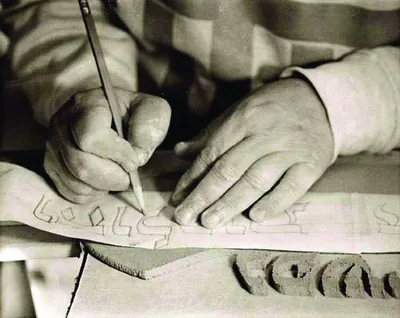
Each donor wall was designed for its building and usually made from two kinds of tile, one carrying the donors' names and the other carved with drawings and traditional texts and glazed in colors chosen for the room. The meditation cylinders were thrown on the wheel with the potter Peter Rose, his mentor in clay, who said he learned as much from Arnold as Arnold did from him. When each cylinder was leather-hard, Arnold carved a shallow grid into its surface and incised Jewish meditations and other texts into chosen squares. He drew his own Hebrew; the art historian Bezalel Narkiss, visiting in 1994, told him he had a font of his own. Across all of the work, the texts come from the Hebrew Bible, the liturgy, and the mystical tradition, and every piece was made to be used.
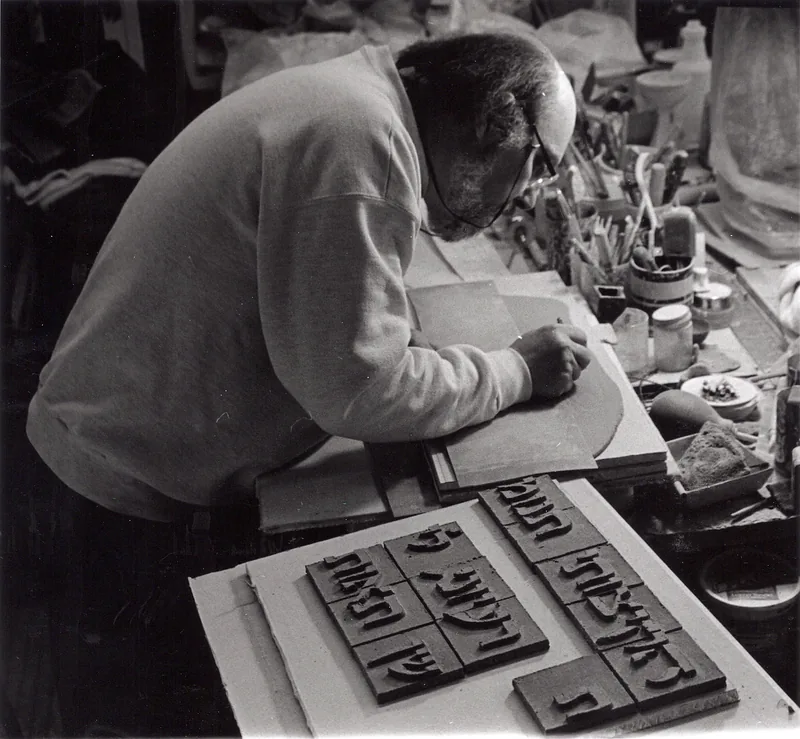
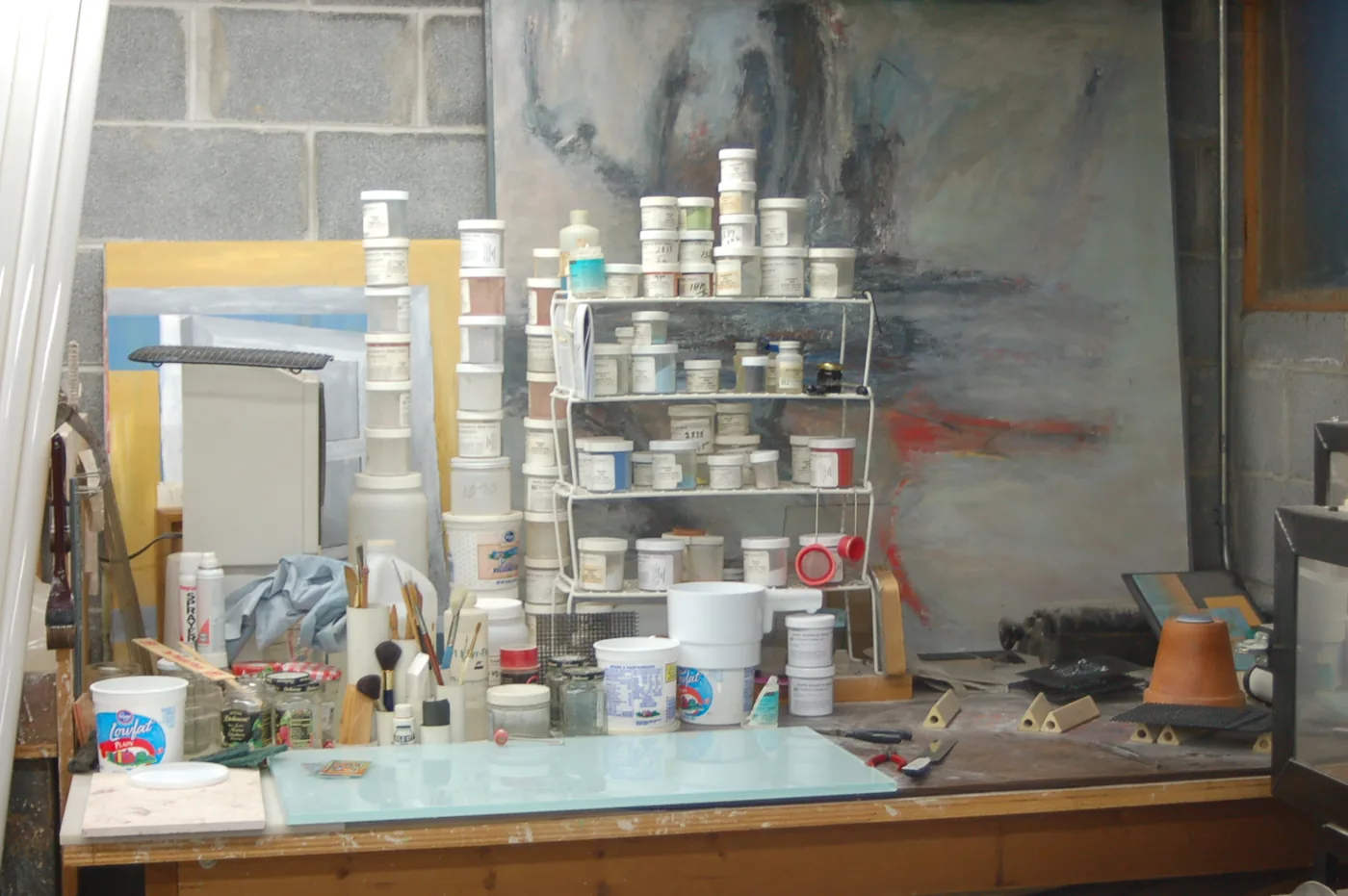
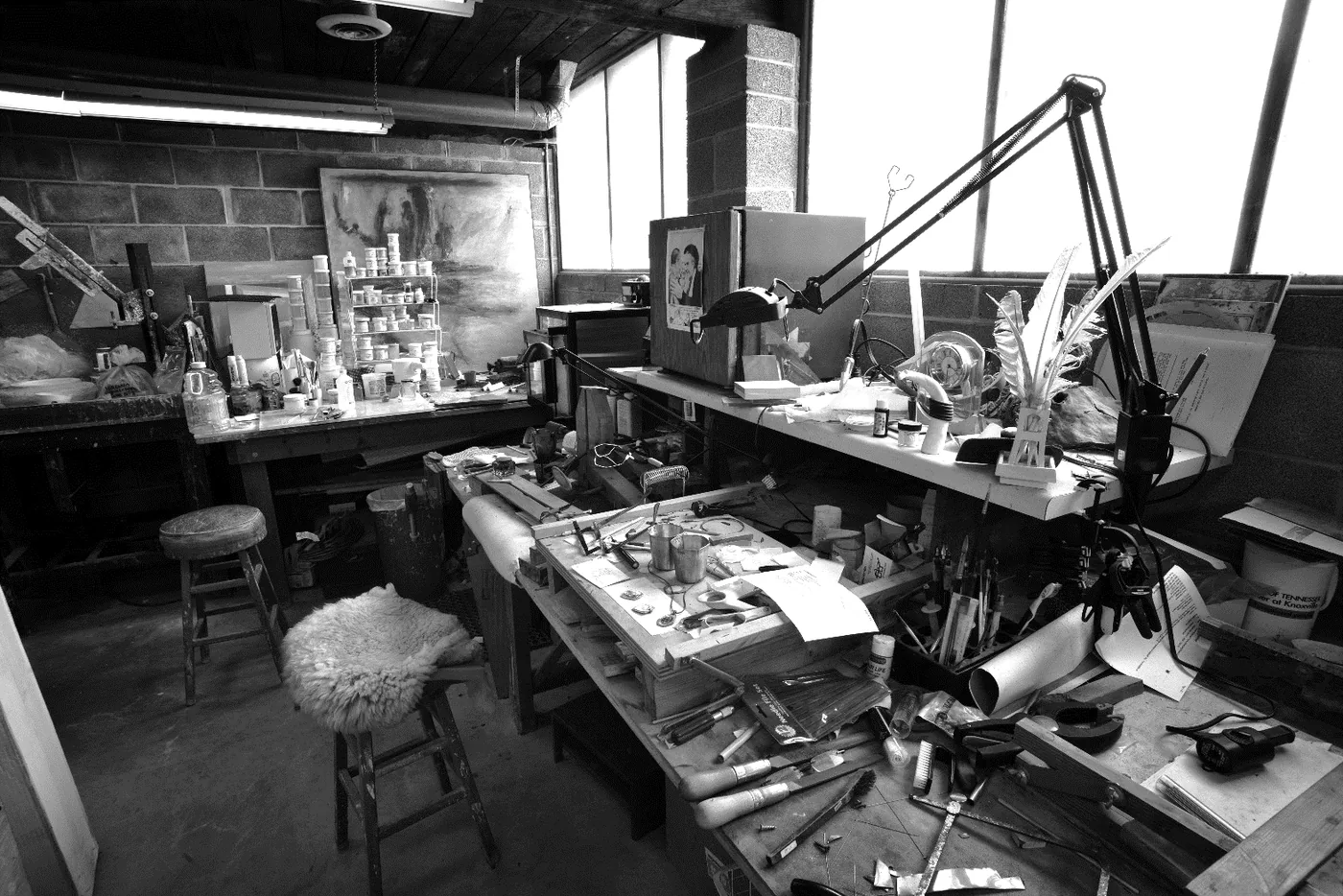
Two collaborators appear again and again. The woodcarver Ernie Gross carved the ark doors Arnold designed, made the frames and stands for the sculptures, and after Arnold's death designed and built the Schwarzbart Gallery. The silversmith Michael Tomlinson fabricated the first eternal light in sterling.
The graphite drawings began in Jerusalem. In 1991, at the International Seminar on Jewish Art, Arnold heard Ziva Amishai-Maisels lecture on the Jewish symbolism in Barnett Newman's painting, turned to David Moss beside him, and said he had to get to an art supply store. Moss drove him to the one on Emek Refaim, and the drawings on Arches paper started that day. When the art historian Dale Cleaver first saw them he took them for prints, and had to be told twice that they were drawn by hand. One of them, "Divine Plenty," is now at the Knoxville Museum of Art.
My sense of Arnold as an artist is that he knew how he wanted something to look and function and figured out the best material for the job. Some artists are driven by and respond to a particular medium, but I think Arnold worked the other way, bending the medium to his vision. I view that quality as a strength.
David Butler, executive director of the Knoxville Museum of Art.
His mark
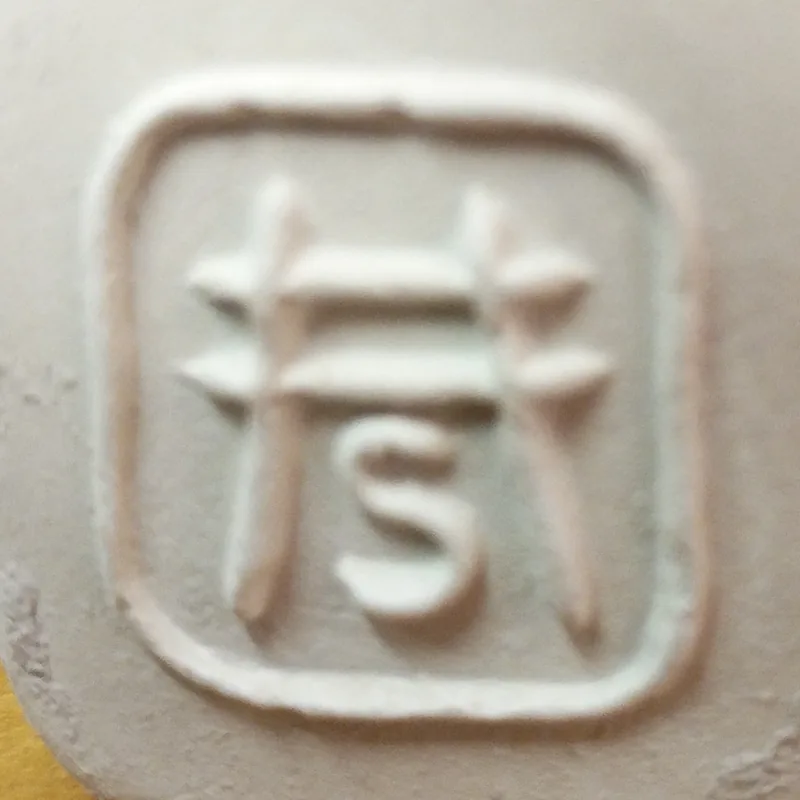
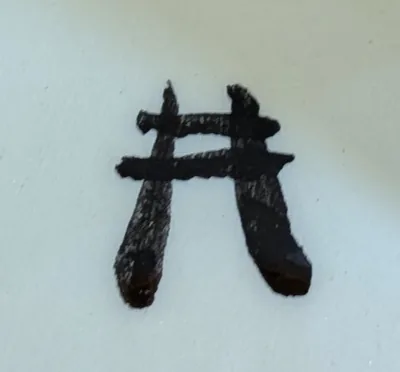
The lion at the head of these pages is his as well. The basalt Lion of Hazor, carved in the fifteenth or fourteenth century BCE and now in the Israel Museum in Jerusalem, became an important image for him after he saw it there. He drew it for the Albany donor wall, where it guards the entrance in unfired clay, and for a menorah in the studio line.
Studies
- 1966
- Bachelor of Arts in zoology, The University of Tennessee
- 1969
- Bachelor of Architecture, The University of Tennessee School of Architecture, in its first graduating class
- 1985, 1988, 1991
- International Seminars on Jewish Art, Jerusalem
- 1992
- The Synagogue Throughout the Ages: Art and Architecture, Hebrew University, Jerusalem
- Arrowmont School of Arts and Crafts, Gatlinburg, Tennessee, and private study with area potters
Architecture
Arnold practiced architecture in Knoxville for twelve years, as a partner in GSW Architecture from 1969 to 1976 and then in Wilcox and Schwarzbart from 1977 to 1981. His buildings include the house he designed for himself and Mary Linda, the Knoxville Zoo's entrance and reptile complex, the L. T. Ross Building, both Copper Cellar restaurants, and the Muse. In 1981 he closed the practice to work full time in the studio, though he kept his license until 2001. The buildings, the firms, and the drawings are described on the Architecture page.
Awards and honors
- 1994
- Honorable Mention, "Visions of Faith," The Parthenon, Nashville
- 1998
- Second Prize in enameling, Mid Rockland Arts Festival
- 1999
- Myer and Selma Mellman Judaica Award, "Contemporary Works of Faith '99"
- 1991, 1992
- Invited to stay at Mishkenot Sha'ananim, the official guesthouse for visiting artists, Jerusalem. He first saw it in 1975 as a Knoxville architect and thought a stay unlikely; the invitation came after Jeff and Nancy Becker carried his portfolio there. He met Herman Wouk in the house, and a letter from Rabbi Adin Steinsaltz led to a few days studying Talmud with him, in English
- 2012
- Knoxville East High Alumni Association Hall of Fame
- 2016
- The Schwarzbart Gallery opens at the Arnstein Jewish Community Center, Knoxville, January 31
Presentations
Work was presented to Vice President Albert Gore, Jr. at the 1995 Jewish Theological Seminary commencement, and by Seymour Reich, President of B'nai B'rith International, to the presidents of Chile, Argentina, and Uruguay in 1990.
Lectures and workshops
- 1991
- Community Craft Center, Norris, Tennessee
- 1995
- "The Art of Arnold Schwarzbart," Hadassah Southern Region Spring Conference
- 1997
- Tolerance and Diversity Teen Program, JCC, Nashville
- 1999
- "The World of Making Judaica," Knoxville Chapter of Hadassah; Visiting Artists and Scholars Program, University of Tennessee Department of Art
- 2001
- Storyteller, "Degradation to Redemption," East Tennessee Holocaust Conference (video)
- 2008
- "Hiddur Mitzvah: Beautifying Holiness," Heska Amuna Synagogue, Knoxville
- 2013
- "Art and Judaism," with Ernie Gross, Heska Amuna Synagogue, Knoxville
Selected collections
- The Schwarzbart Gallery at the Arnstein Jewish Community Center, Knoxville
- Knoxville Museum of Art, which acquired the meditation cylinder "The Awesome Name" in 2016, and holds the graphite drawing "Divine Plenty" (about 1991), given by Mary Linda Schwarzbart in his memory
- B'nai B'rith Klutznick Museum, Washington, DC
- Judah L. Magnes Museum, Berkeley
- Hebrew Union College-Jewish Institute of Religion, New York
- Mollie and Louis Kaplan Museum of Judaica, Houston
- Rosenbaum Collection, Heichal Shlomo, Jerusalem
- Beth El Temple of West Hartford; Beth Sholom Synagogue, Elkins Park; Temple Emanu-El, Palm Beach; The Jewish Home of Greater Harrisburg
- Heska Amuna Synagogue, Knoxville, his own congregation, which holds the Jerusalem Wall, the seder plate and Elijah's cup, the "Before Me Always" print given by the confirmation class of 1988, and one of the Five Easy Pieces. The synagogue's page on his work walks through the building.
- Vice President Albert Gore, Jr.; Rabbi Adin Steinsaltz; Rabbi Lawrence Kushner; Rabbi David R. Blumenthal; Alan Dershowitz; Shoshana Cardin; Belle Rosenbaum, who bought the first omer counter
Community
Arnold served as president of the Arnstein Jewish Community Center and of the Knoxville Jewish Federation, and chaired the committee that merged the two into the Knoxville Jewish Alliance. He was president and board chair of Heska Amuna Synagogue and a past president of his AEPi chapter. He sat on the boards of the Dulin Museum and the Beck Cultural Center and on the exhibition committee of the Knoxville Museum of Art. In the craft world he was a board member of the American Craft Council, the Arts and Culture Alliance of Greater Knoxville, the Southern Highland Craft Guild, and the Tennessee Association of Craft Artists, a member of the American Guild of Judaic Art, and a Hadassah Associate. He served on the East Tennessee Foundation's Youth Endowment Advisory Board and for several years on its arts grant panel. He also designed several headstones in the community's cemetery; after his death Ernie Gross designed his.
Archive
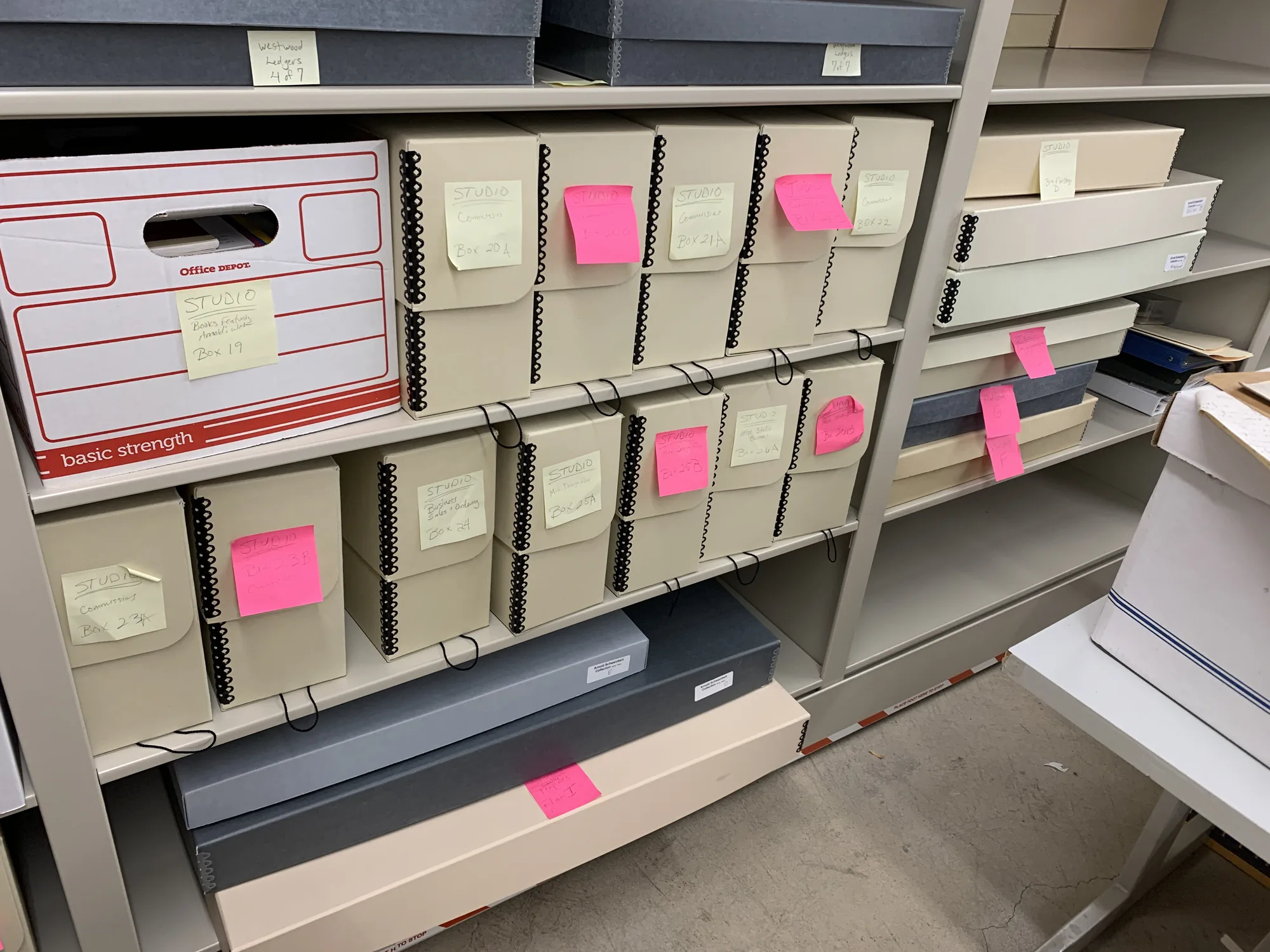
Arnold's papers are held by the Knox County Public Library as the Arnold Schwarzbart Collection, MSC 0576, part of the Calvin M. McClung Historical Collection. Mary Linda Schwarzbart spent two years deciding where they should go. The architect and friend Lou Gauci, whom she consulted, argued that a body of work so rooted in Knoxville should stay in Knoxville, and on April 12, 2017, she settled on the McClung Collection. Its manager, Steve Cotham, came to the studio that week, and the architectural drawings and carved printing plates went first, in the summer of 2017, with archival materials paid for by a grant from the Arts and Culture Alliance. The collection covers 1951 to 2015 and fills thirty-five boxes with documents, photographs, posters, printing plates, architectural plans, and objects from the studio and the architecture practice.
The one extended study of the work is Ori Z. Soltes's 2019 essay "To Glorify Sacred Space: The Synagogue Art of Arnold Schwarzbart," written with Mary Linda Schwarzbart's help and reproduced here in full.
His curriculum vitae, last revised in 2023, is available here as a PDF. The commissions, exhibitions, and collections it lists are also on the Commissions and Exhibitions pages.
Researchers can see the material by appointment at the East Tennessee History Center, 601 South Gay Street, Knoxville, third floor. Contact the archivist at mcclung-archivist@knoxlib.org or 865-215-8814.
From 2017 Mary Linda documented the work and the placing of the archive on a site she called the Legacy Project. Its contents are now part of this site, and the eulogies and tributes it gathered are collected under Remembrances.