
An essay
To Glorify Sacred Space1
The Synagogue Art of Arnold Schwarzbart
The one extended scholarly treatment of Arnold Schwarzbart's work, written in 2019 by the Georgetown art historian who first showed his pieces at the B'nai B'rith Klutznick National Jewish Museum in 1997 and knew him from then on. Written with Mary Linda Schwarzbart's help and intended for the journal Arts, it has not appeared in print. The text is reproduced here in full from the family's copy.
The author's typescript called for sixteen figures but carried no photographs. The images here are the pieces he named, drawn from the studio's own photographs elsewhere on this site; each caption links to that piece.
The original typescript (PDF, 13 pages)
“…and I have filled him with the spirit of God, in wisdom, and in understanding, and in knowledge, and in all manner of workmanship, to devise skillful works, to work in gold, and in silver, and in brass…” Exodus 31: 3-4
1. Introduction: Art, the Synagogue, and Jewish Artists
From the beginning of human creativity, visual art has played a sacerdotal role in communicating human thoughts about divinity and our relationship to it that cannot be fully articulated with words. The artist offers a parallel sort of figure to the prophet and the priest, inspired—inspirited—to emulate divinity by creating and connecting humanity to divinity. Art associated with religious ritual and ceremony intensifies and focuses this truth in being sacerdotal both as art and as part of ritual. So the vocabulary of visual décor in sacred spaces like the synagogue responds both to the broad urge to create art as part of the urge to connect to God and as a response to the specific features of Judaism in its desire to visually glorify God while never mistaking God as visual.
The synagogue has functioned historically as a meeting place between God and Israel. Its architecture has resonated with this role. The elevated placement of the edifice among the structures of the community prescribed by the Talmud is intended to connote a reaching up toward heaven merely by the need to ascend in order to enter its space. That symbolic message is re-enforced—doubly—by the two raised spaces within its traditional interior configuration: one (the aron/hekhal) to accommodate where the Torah scrolls—the word of God in its purist, most unalloyed form—are kept, and a second (the bamah/tevah) where the scrolls are placed to be read and discussed during the morning service, three times a week.
When, in the long medieval period, the exterior of the synagogue necessarily remained unelevated and barely noticeable—buried in the community by the prescriptions of the prevailing authorities across the larger Christian and Muslim worlds in which Jews were scattered—its interior elements more emphatically than ever echoed its spiritual purpose. This extended from the diverse ways in which the double interior elevation was effected to the decorative embellishments of its walls and ceilings to the ways in which the Torah and its paraphernalia were visually enhanced.
This last feature in particular reflected the interpretive direction taken by most Jewish communities in response to the words of Moses, uttered in celebration of the safe transit by the Children of Israel through the temporarily dry bed of the Sea of Reeds and the destruction of the pharaonic troops pursuing them in the onslaught of the returning waters (Ex 15: 2): “He is my God and I will glorify him!” For the Hebrew “vi’anvehu” can also be translated “I will decorate him.” Since the invisible God cannot by definition be decorated, and since the closest, most direct, tangible aspect of the intangible God is God’s word in the Torah—and given the medieval Jewish abhorrence of decorating that word with the sort of illuminations and illustrations endemic to the Christian world—there evolved a series of important visual elements pertinent to the Torah: soft and hard coverings, crowns, finials, breastplates, and pointers.
All of these objects resonated from what evolved not merely as a desire to glorify God by beautifying the container of God’s word, but as a sense of imperative—a virtual commandment to do so, referred to as “beautifying mitzvah”: hiddur mitzvah. The phrase is associated with the comment on Exodus 15:2 offered in the Talmud (Baba Kama 9B) by Rabbi Zera. These notions, within the Torah and the rabbinic discussion that its text demands, reverberate with symbolic language expressing the divine-human relationship. The crown suggests royalty and thus both the idea of the Torah as possessing a Davidic (and therefore messianic) implication and that God’s word is as royal as it gets for Jewish human-divine aspiration; the breastplate represents the breastplate worn on the chest of the High Priest in the Temple and thus underscores the Torah’s role, like that of the High Priest, as the consummate intermediary between God and the People Israel. The pointer, used to read the text that is written without vowels or punctuation, both re-enforces the letter-by-letter focus demanded by God’s word and the sacredness of the scrolls that one ought not soil with one’s (inherently oily) human fingers.
The decorative details of these and other synagogue-centered objects offer a varied language of symbolic dialects. Thus the seven-branched candelabrum, for instance, frequently appears, alluding to the menorah that burned eternally in the Jerusalem Temple and also, in its sevenness, to the commandment to keep the seventh day holy and its connotations of covenantal promise and responsibility. So, too, the pair of columns that also allude, by synecdoche, to the Temple by way of alluding to the pair of columns named Yakhin and Boaz that are referenced in I Kings 7:13ff as standing before the Temple built by the Tyrians for King Solomon. Depictions of the Decalogue stand for the Torah itself, and lion forms allude to the house of David and Solomon—and thus connote messianic hope—as well as to the tribe of Judah from which they come—for Jacob-Israel, in his deathbed benediction of his sons, likened Judah to a lion’s cub, in Gen 49:9. Bells, particularly those shaped like pomegranates, recall the pomegranate-shaped bells that hung from the High Priest’s robes, so that he could be heard moving about within the Temple courtyards and people might give way to him—to note just a few decorative elements.
The irony is that, throughout the medieval period, for the most part, Jews across Christendom were not positioned to create their own ritual objects, whether with regard to the Torah or to any other aspects of Jewish communal and private life, inside the synagogue or inside the home. The guilds in which youths were trained in the skilled working of metals were typically closed to Jews—who obviously could not take an oath of membership that included the words “in the name of the Father, the Son, and the Holy Spirit.” So most Judaica was devised and no doubt designed by Christian craftsmen. (In the Muslim world the opposite was typically true: working with precious metals was looked down upon as tantamount to the objectionable practice of demanding interest for a loan. So the working of such metals most often fell to the Jews.) The conditions within Christendom changed slowly. The spiritual crises provoked by the Protestant Reformation, Catholic Counter-Reformation and Age of Religious Wars that followed, between the early 16th and early 18th centuries, coupled over the century after that with industrial, technological, scientific, political, philosophical and theological revolutions, began to open up the world for Jews in many places. From the margins of society, they found it increasingly possible to join the mainstream in socio-economic and cultural and sometimes even political ways. One outcome of this was that, by the mid-19th century there was a burgeoning of Jewish participation in the visual arts, from the genre paintings of Morris Oppenheim to the impressionist landscapes of Camille Pissarro, continuing in the 20th century from the stylized portraits of Amedeo Modigliani and the cubist sculptures of Jacques Lipschitz to the abstract paintings of Mark Rothko.2
2.1 Arnold Schwarzbart and Ceremonial Art
An apposite consequence of all this was the eventual role played by Jews in the production of Jewish ceremonial art by the early 20th century. The pace of increasing participation—both in painting and sculpture and their concomitants and in creating ceremonial art—underwent a precipitous upsurge in the aftermath of the diverse racial, genderal, ethnic and national identity movements that began in the late 1960s and early 1970s, and which have continued up to the present day. Among the myriad Jewish artists whose productivity has included a diverse exploration of Judaica and a rich turn toward glorifying God by glorifying the synagogue and its appurtenances, was Arnold Schwarzbart (1942-2015).
Schwarzbart was born in the Soviet Union—his mother’s family was originally from Tarnopol, Ukraine—in the middle of World War II. His family moved to Vienna after the war and in 1951 to the United States, settling in Knoxville, Tennessee. He attended the University of Tennessee and spent 13 years thereafter as an architect. He also became interested in Judaism and both its mystical tradition and its ceremonial objects. By the 1980s he had begun to focus his creative intensity with increasing exclusivity in clay, in which medium he produced a growing array of Kiddush cups, Seder plates, hanukkiyyot, and tz’dakah boxes; his repertoire of Judaica expanded as he left architecture behind in favor of objects that embellish the synagogue and Jewish home.3
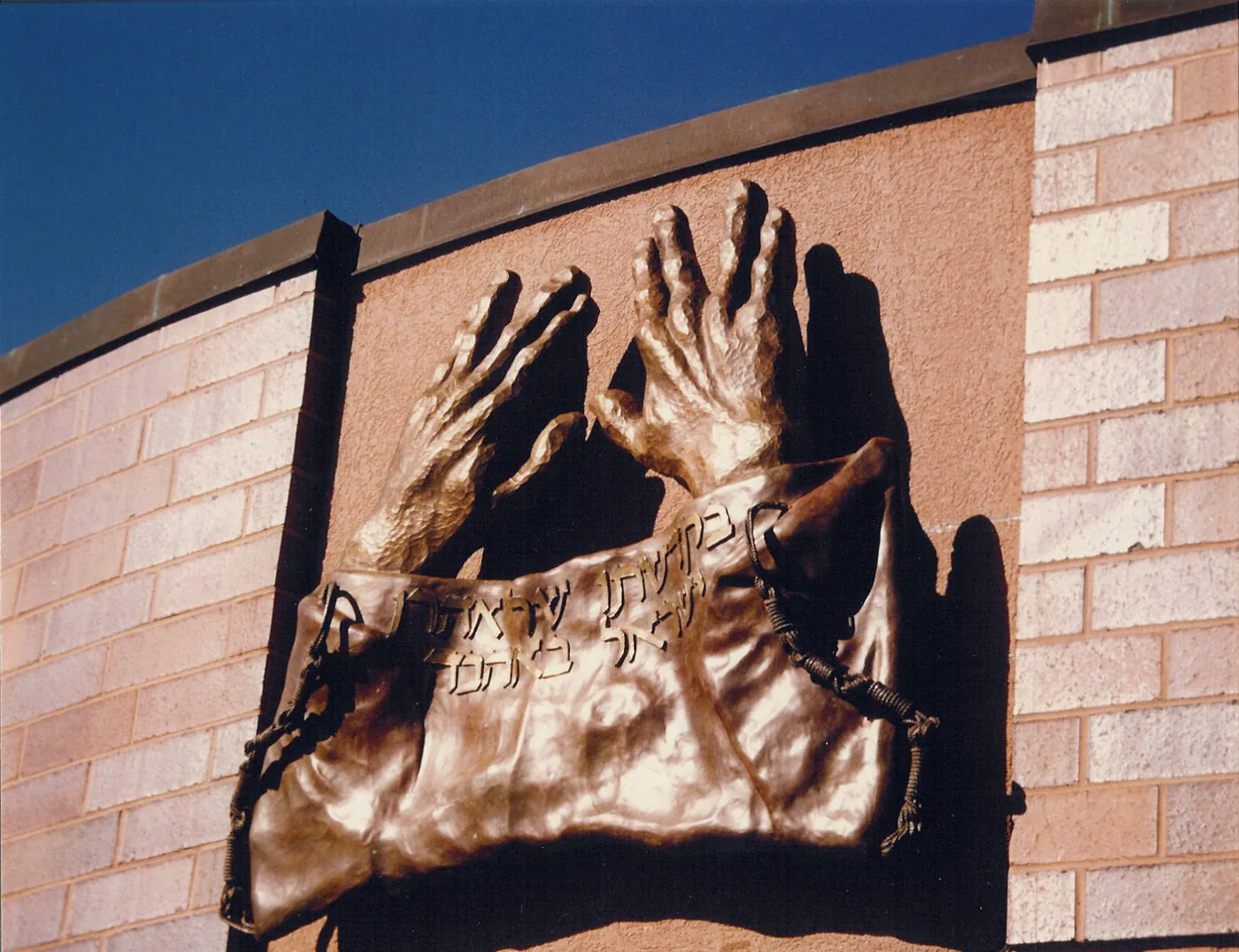
Schwarzbart was an extraordinary artist whose work offers an enduring contribution to visualizing the invisible in spaces in which Jews have directed their prayers for millennia. His art festoons synagogues across North America, inside and out, in diverse media, from clay and bronze to wool and cotton to gold leaf and patinated copper. American synagogues have proudly affirmed their presence within the community over the past two centuries in increasing numbers with bold exterior statements, in both their architecture and their adornment. Among Schwarzbart’s contributions to this process is a 3’ x 4’ bronze 1996 sculpture embellishing the uppermost part of the outer wall of Kehilat Israel synagogue in Overland Park, Kansas. The work contrasts with the strict geometries of the building facade’s brickwork: two upraised hands, formed in the configuration traditionally associated with the Temple priest (the patron of the sculpture was a Kohayn!)—configured as the Hebrew letter shin—during his three-fold blessing of the community, rise from an undulating tallit (prayer shawl), with its tzitzit (knotted fringes) in a contrastive, darker bronze. The central words from the priestly benediction are inscribed in Hebrew letters across the upper part of the work.
2.2 Schwarzbart’s Art Within the Sanctuary
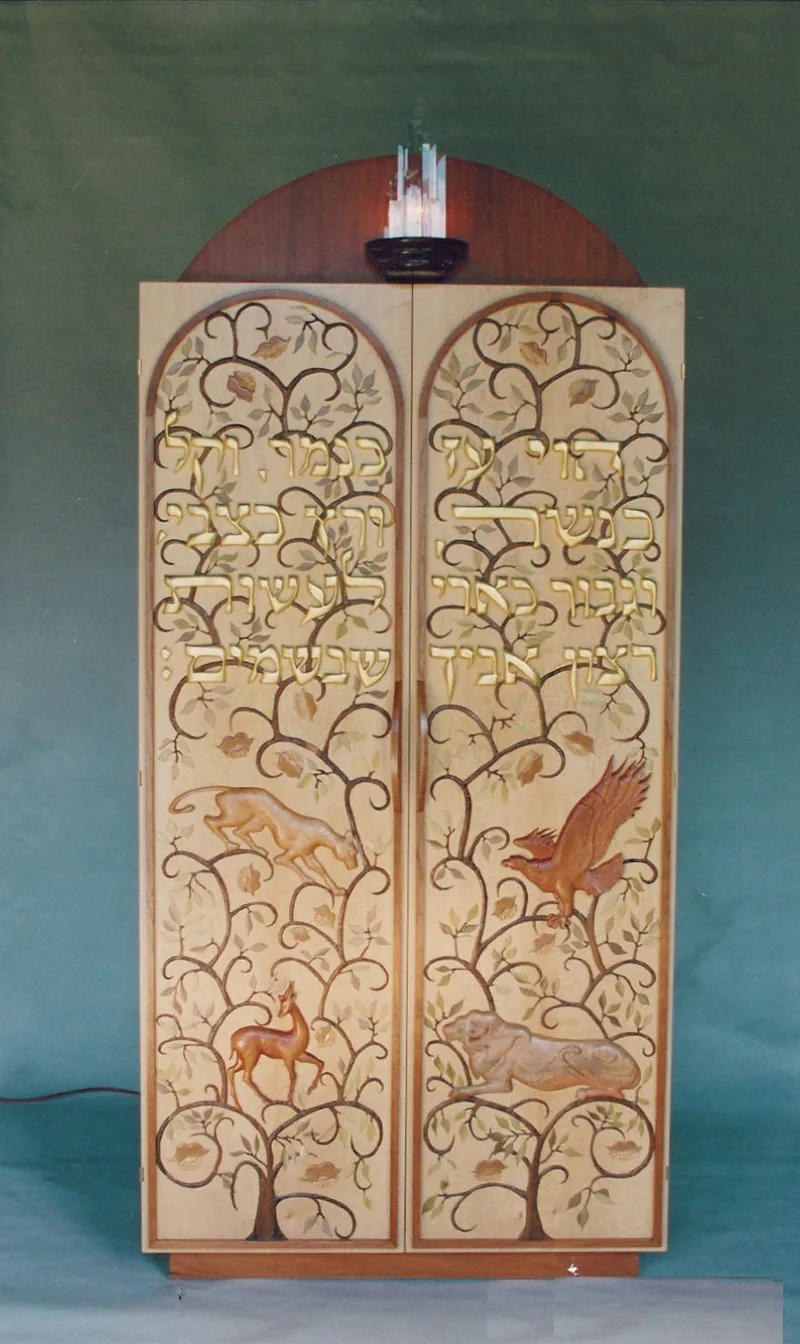
Within the synagogue, the central architectural, spiritual and liturgical focus is the Holy Ark in which the Torah scrolls are kept. Schwarzbart teamed up several times with woodcarver Ernie Gross—who carved what Schwarzbart conceived and designed—as, for instance, in order to produce the exquisite doors for the ark of Temple Sinai of North Dade, North Miami Beach, Florida, in 1993.4 Diversely-hued woods depict a quartet of animals cavorting through the branches of a complexly-branched, lyrical tree against a golden background. Higher-relief-carved Hebrew letters of gold quote the Talmudic passage from Pirke Avot (Sayings of the Fathers): “you must be bold as a leopard, light as an eagle, swift as a deer, and strong as a lion to fulfill the will of your Father in Heaven.” Inspired by an 18th-century pair of Ark doors from a prayer room in a private home in Unterlimpurg, Germany, three most obvious changes were introduced by Schwarzbart: the German doors were brightly painted (as were the wood-paneled walls and ceiling); the framing shape for them was squat and rectilinear, rather than the more attenuated double arch-cum-decalogue shape created by Schwarzbart; and he added the motif of the animals.5 The imagery weds the rabbinic passage—with its four creatures perceived by the artist as a metaphor for the four letters (the Hebrew equivalents of YHVH) comprising the ineffable Name of God—to the idea of the Torah (the guide, with its 613 commandments, regarding how to fulfill the will of your Father in Heaven) as a “Tree of Life to them that hold fast to it.”6
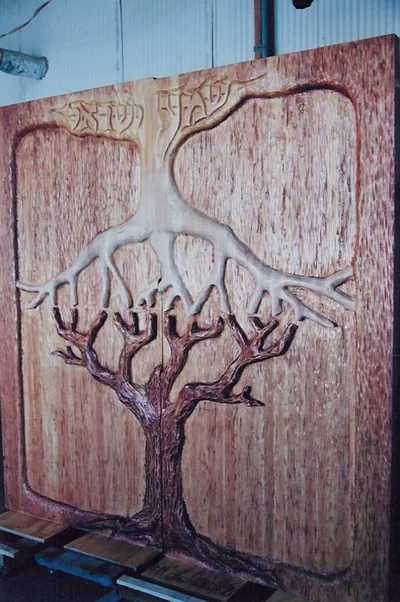
That last concept swallows the entirety of the wooden ark doors upon which Schwarzbart and Gross partnered for Temple Beth Hillel, in South Windsor, Connecticut, in 2000. There, a dark-wooded relief-carved tree rises from its roots to four sets of three upper branches; thus: 12 branches—so the four-lettered name of God has become consonant with the twelve tribes of Israel—and, generation to generation, supports a second, light-wood-colored tree. A second glance makes one realize that the upper tree is not simply supported by the first, but meets it, from the top, with its thick roots, down to its extending branches. The Torah is “the place where heaven and earth meet”—the theme chosen by the congregation for these portals—the doors themselves are the meeting place between the congregation and the word of God. And the imagery, further, connotes the notion expressed in the mystical tradition that, as the mystic aspires to and reaches toward God, God aspires to and reaches toward the mystic. Thus the congregation embraces the idea of participating en masse in acts of piety—hassidut—so that, as a group they can help each individual toward the righteousness (tzadikut) that brings us closer to the hidden mystery conveyed by the ineffable four-lettered Name of God.
God’s presence is accessible at all times and in all places—albeit, in symbolic terms, most particularly present before the gates of the Holy Ark. That Presence—the Hebrew word is shekhinah—is traditionally expressed in the décor of the synagogue by the eternal light—the Ner Tamid—that hovers on high before the ark. Schwarzbart had a particular affinity for devising such objects, typically with a beaten bronze “bowl” hanging from a trio of carefully wrought bronze chain links, and with multi-colored beveled glass cylinders rising upwards from the bowl, diffusing the light, symbol of God’s Presence as emanating in prismatic directions. For the Kollel of Greater Boston, in Boston, Massachusetts (2009) the array was comprised of blues and greens—like the sky and the water, recalling the passage in Gen 1:6-8 that refers to the firmament that separated the waters below from the waters (i.e., heavens) above.
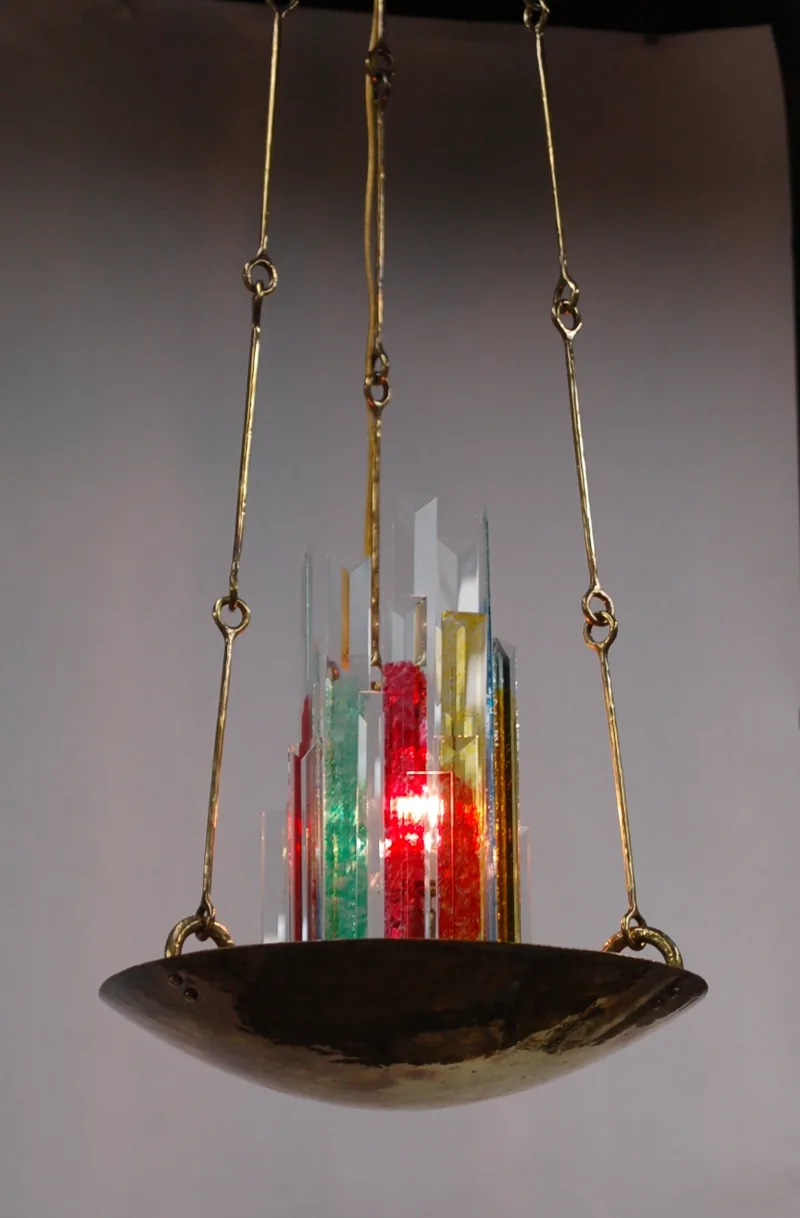
For the West End Synagogue in Nashville, Tennessee, (2007) the glass bevels are blood-red, blue, yellow, and green, suggesting the colors of the covenantal rainbow after the Great Flood. For Bet Tikvah in Santa Fe, New Mexico, (2007) the bowl and chains are forged sterling and the glass bevels suggest the desert, with colors that emphasis the yellow sweep of a sand-dominated landscape and the light blue of an endless sky.
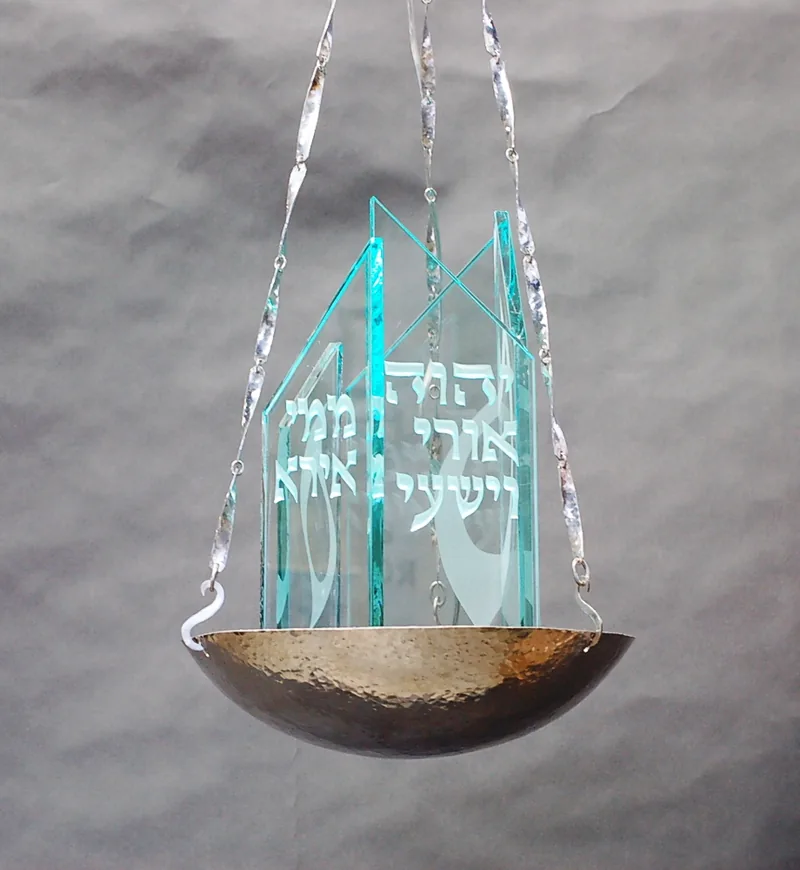
For Temple Beth Or in Dayton, Ohio, (1990), the sea-green glass rising from the bronze bowl is inscribed with Hebrew—spelling out the name of the congregation, which means “House of Light” and with words referring to God’s giving of the Torah. For Temple Bet Yahm—“House of the Sea”—in Newport Beach, California, (2010) three pale, sea-blue slabs of glass rise from the sterling bowl. The slabs are inscribed with the words, in Hebrew, “the Lord is my light and my salvation; from the waters of salvation I shall seek hope”. For yet another lamp, that for the Rabbi Leo Trepp Chapel in the California Veterans’ Home in Yountville, California (1993)—for which the artist also created silver decorations for the Ark doors and the readers’ lectern, as well as a Holocaust Memorial Lamp—the sterling bowl and diamond-shaped chain links are complemented by an agglomeration of clear glass rising from the bowl.
Appropriate to their role as visual symbols of shekhinat haElohim (“the Presence of the Lord”), these Eternal Lamps—all formed along virtually the same general design lines and each shaped according to unique details—offer a visual equivalent to the voices of the Hebrew biblical prophets. Each prophet is like a conduit of differently colored glass through which the unchanging and clear water of God’s words passes; each prophet’s individual voice colors those words with the style and tone of his individual personality. As each prophet is a verbal instrument connecting God to the people of Israel and Judah, each Ner Tamid is a visual instrument of God’s connection to the congregation and the diasporic community that it represents, as it hangs before the Holy Ark—in which the words of God, carefully inscribed by hand on parchment, are lovingly stored—and soars above the raised place from which the words of the Torah and prophets are read and expounded.7
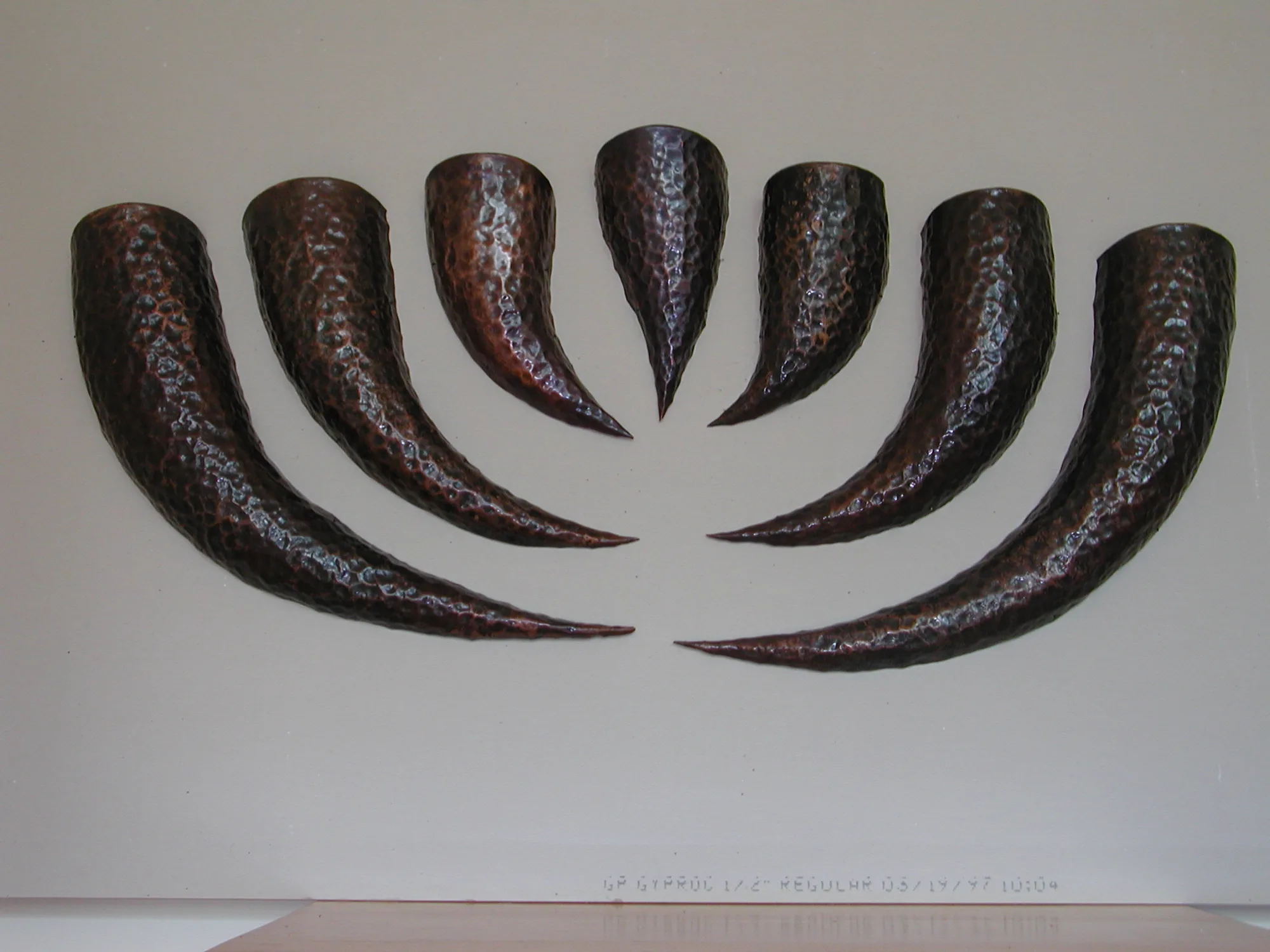
Light both actual and imagined may be found in synagogues and in Schwarzbart’s art for synagogues. One of the many ways in which the sanctuary has, over the centuries, offered references back to the Temple in Jerusalem is by the presence within it of a seven-branched menorah—whether through images in the wall paintings in the synagogue at Dura Europus on the Euphrates River (ca 245 CE) or in the mosaic floor of the Bet Alpha synagogue in the Galilee (ca 525 CE), or whether as full-sized structures standing on the pulpit in hundreds of medieval and modern synagogues across the Jewish diaspora. Schwarzbart introduced a uniquely conceptual seven-branched candelabrum into Temple Emanuel in Winston-Salem, North Carolina, in 2002, by suspending seven rough-textured, hand-forged patinated copper tubes on the upper wall to one side of the Holy Ark. The 3’ x 6’ work shapes these tubes—all of them with pointed bottoms gathered together in the lower center and curving out and up to full roundness—in an expansive menorah configuration.
In the modern synagogue, wall-adorning forms of light-filled visual expression, typically within the sanctuary proper, include the continued commemoration of members of the congregation who have passed away—sometimes as an extended name-filled plaque, with a light by each name, illuminated during the specific anniversary of a given individual’s death. So, too, individual memorial lamps—yahrtzeit lamps—sometimes appear. In both cases the artfully formed lamp or wall of lamps offers another variation on the idea of connecting—the dead and the living as a metaphor for divine and human, expanding the conceptual vocabulary of the sanctuary within the synagogue as a place marking the meeting between realms.
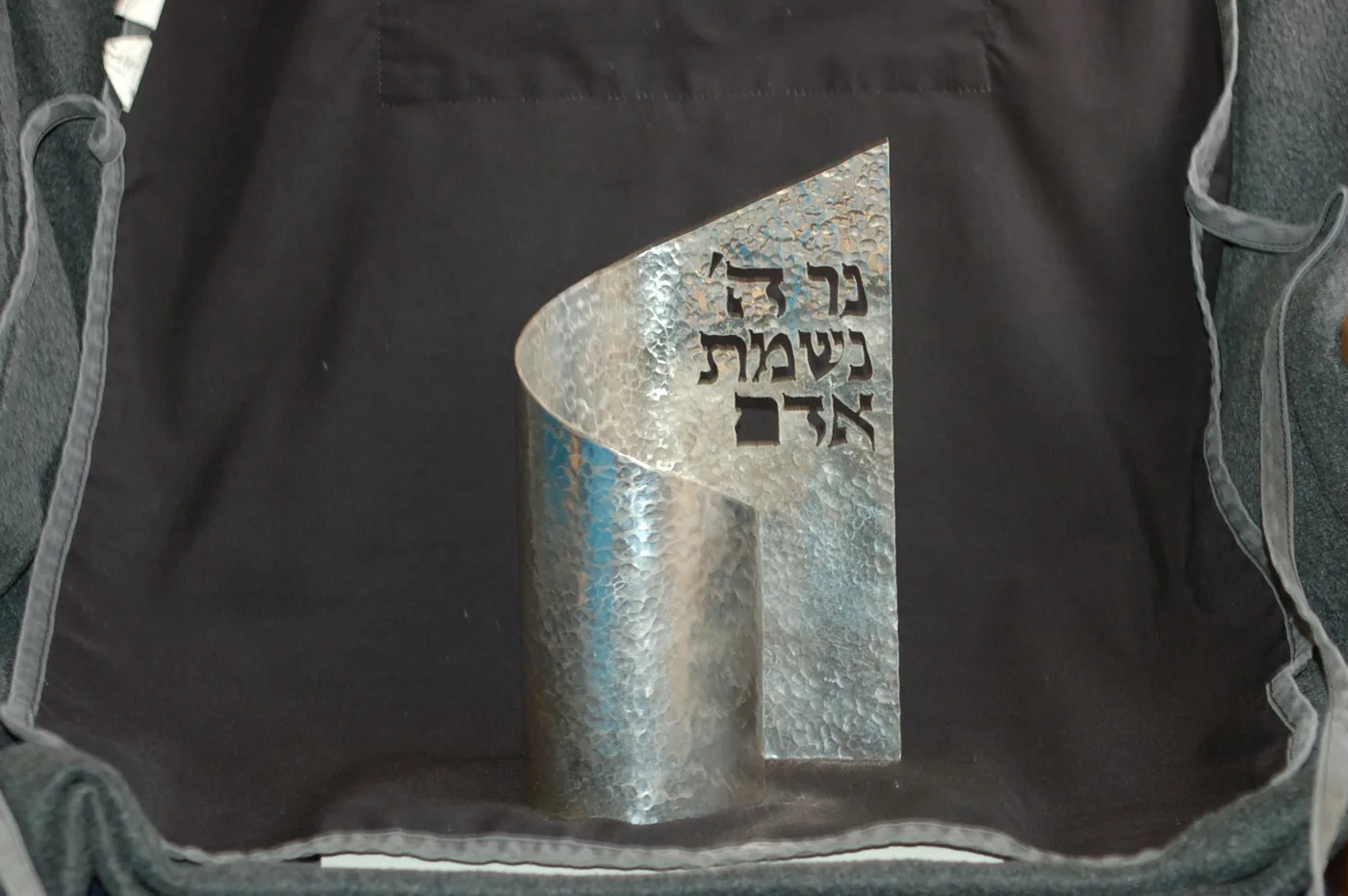
Among Arnold Schwarzbart’s more delicate memorial lamps is a 9” high one created in 2010 for Temple Bat Yahm, (Newport Beach), made of hand-hammered sterling silver mounted on a dark wooden shelf. The metal is shaped like the fragment of a scroll, its upper edge ascending in crossed diagonals like a stylized flame; the lower front circle becomes a carapace for the candle whose evanescent light reverberates from the higher back “wall” unfolding to the right—which is perforated with Hebrew letters comprising the words: “the candle of the Lord is the soul of man”. A second instance of this design, but with different materials, from 1995, submerges copper in a brilliant red enamel skin, and offers the same words applied in gold leaf to the surface.
2.3 Synagogue Art Beyond the Sanctuary
The congregation as a sacred community, in which memory prevails both individually and as an extended family, reaches back through Jewish history along any number of pathways associated with commandments regarding how to make the world a better place. Whether by attempting to engage all 613 commandments strewn throughout the Torah or exploring and explaining the essence of the twice-articulated Ten Commandments or through centuries—millennia—of interpretive discussions across the diaspora, Judaism has been imbued with this imperative: the word “mitzvah”—commandment—evolves into everyday vocabulary, in which it means “good deed.” Thus good deeds are commanded by God, not as something special, but as part of everyday behavior.
Among the many mitzvot, tz’dakah—meaning “justice” or “righteousness”—evolves to be associated most commonly with helping those who have less than one possesses, financially or otherwise, and thinkers like the Spanish-born theologian and physician, Maimonides (1135-1204), suggested a distinct hierarchy of kinds of tz’dakah.8 Beyond these, throughout medieval and early modern central and eastern Europe the most obvious communal form of tz’dakah revolved around the hevrah k’deeshah (“Sacred Society”) whose job it was to assure that every member of the community was cared for, through to death and burial. One of the more obvious translations of these obligations that evolved in America was and is the funding of the synagogue and its institutions: from building and maintaining the edifice itself to sustaining its spiritual and educational programs.
Not surprisingly, then, the interior embellishment of many synagogues includes adornments that reflect on the generosity of members of the congregation, and in the hands of an artist like Arnold Schwarzbart, donor panels become both works of art and visualizations of the abstraction of fulfilling the sacred duty of tz’dakah. This is most literal, perhaps, in the donor wall that he created for Congregation B’nai Amoona, in St Louis, Missouri in 1999. It is shaped as a series of six—like the number of orders in the Mishneh and thus, of the Talmud—dark wooden “frames” (open at the bottom). The work offers tawny and brown- colored stoneware fragments, mounted beneath the glass within each “frame”—as if these were pieces in an archaeological museum—and they are inscribed with white, low-relief Hebrew letters. These form texts—from the liturgy—that pertain to tz’dakah as justice and righteousness or that reflect on God as a God of mercy and patience. The names of donors are silkscreened in a deep blue—the color associated with the tallit fringe—onto the glass.
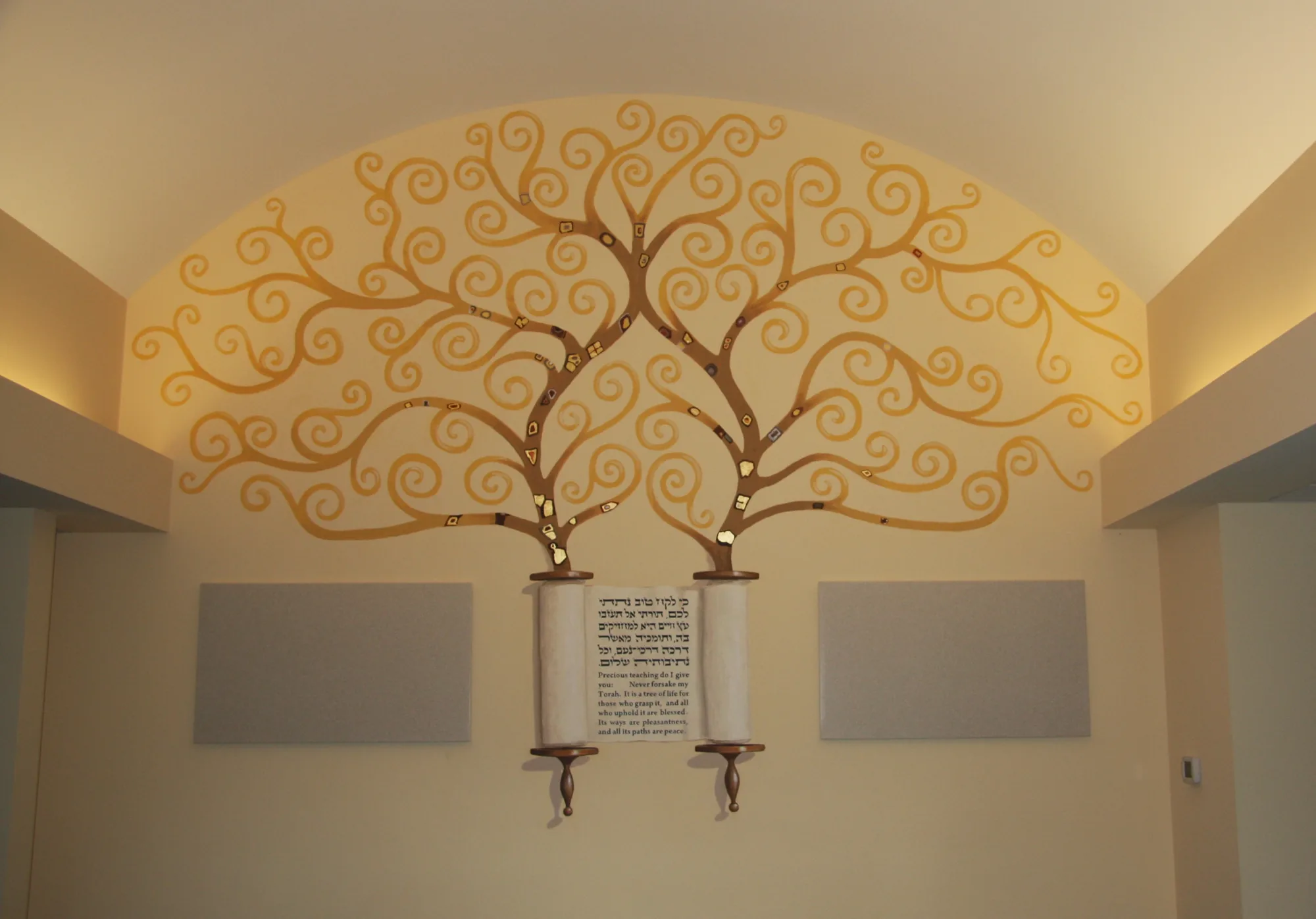
Very different in visual conception is the donor wall done for the Jewish Congregation of Oak Ridge, in Oak Ridge, Tennessee (2008), for which the artist mounted a Torah scroll-shaped relief on the wall and, inspired by the paintings of Gustav Klimt, painted a mural (assisted by his friend and fellow painter, Jim Wyatt) of two branches growing directly out of the rollers—and as they grow, they both form the shape of a crown and spread and become narrower, branch by branch. As the double tree-become-crown expands outward and up toward the ceiling, the color of the wood gets lighter and lighter. Along the myriad branches of this “Tree of life to them that hold fast to it,” the names of donors are placed on small gold-colored plaques.
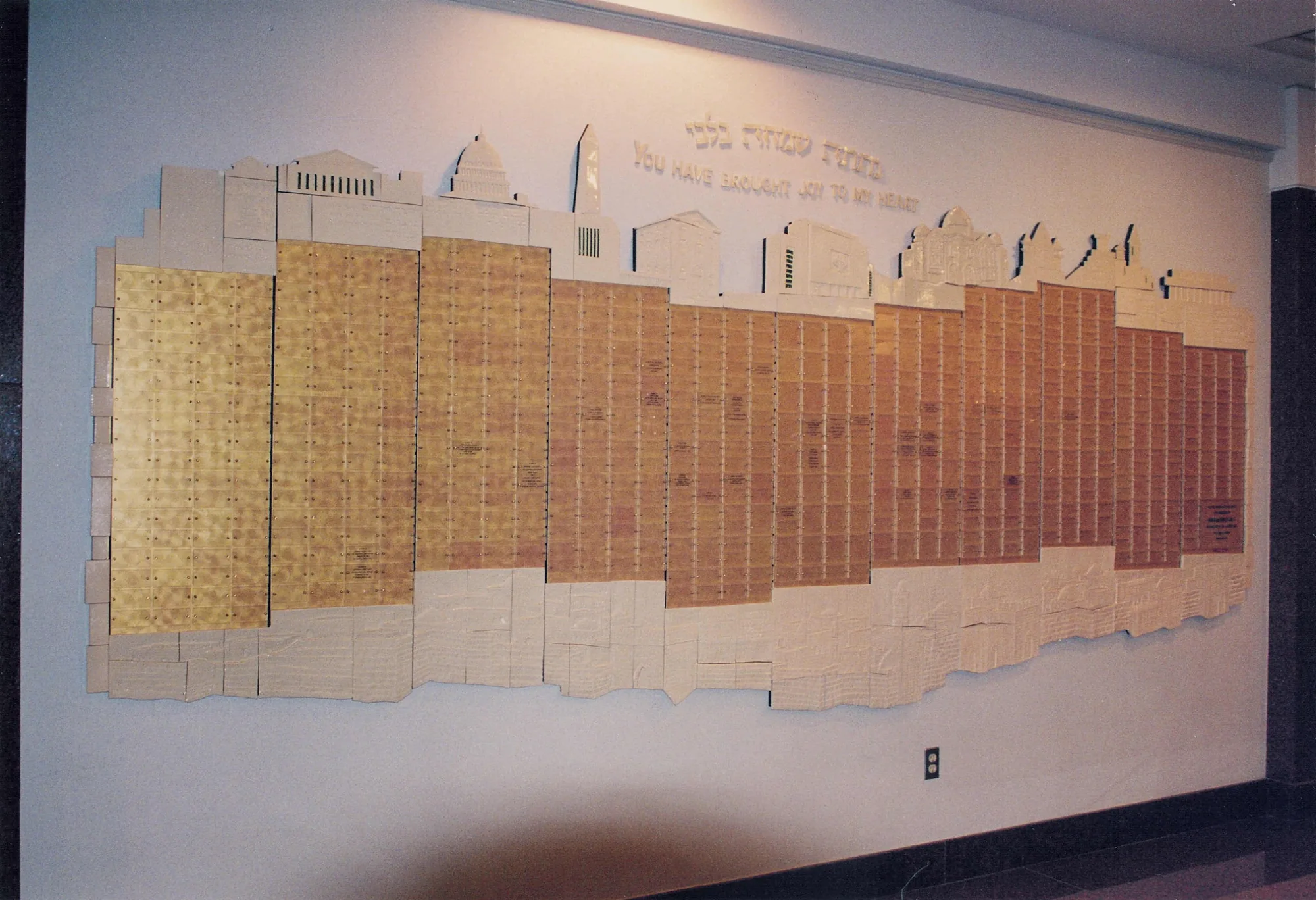
Among the diverse forms that Schwarzbart gives to synagogue donor walls one might note one more: that done for the oldest Jewish congregation in our nation’s capital. The enormous (17 ft wide x 7 ft high) 1995 work for Congregation Adas Israel (in the third of the buildings that it has inhabited since its birth in 1876) in Washington, DC, an undulating series of rectilinear gold-leaf plaques with donor names inscribed upon them rest against a double backdrop of pale, pinkish-white porcelain slabs. Those above, smooth-textured, offer a stylized skyline of Washington, DC (including silhouettes of each of the three buildings that shaped the congregation’s history); those, rough-textured, below, suggest the stone walls of the Old City of Jerusalem.9 The community’s double sense of identity as Americans and as Jews—and as a bridge between the city of God on its hills (below the names) and the city on the hill of human hope (above the names)—is handsomely articulated.
Donor walls usually embellish spaces outside the sanctuary itself, placed as a kind of visual bridge between the world of the synagogue in all of its less overtly spiritual activities and the purely Torah-and prayer-focused identity of the sanctuary—analogous, in a way, to the architectural formation of the Jerusalem Temple, with its outer, middle and innermost courtyards, which offered a hierarchy of sacred participation that led to the Temple edifice with its own tripartite subdivision: an entry corridor, a main area, and the Holy of Holies in which the Tablets of the Law were kept and into which only the High Priest might enter—and only once a year, on the Day of Atonement.
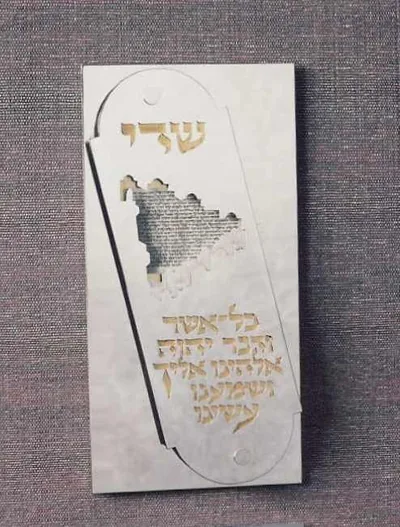
One of Schwarzbart’s exquisite sacred objects designed specifically to mark the boundary between realms within such a conceptual and spiritual hierarchy—a 12” high mezzuzah (literally, in Hebrew: “doorpost”) made in 1999 for the doorway into the sanctuary of Knoxville’s Temple Beth El—is devised of sterling silver. Made to honor the congregation’s retiring rabbi, it is shaped as an oblong placed at the appropriate, traditional angle for mezzuzot against a rectangular backing, with an opening through which one can see part of the Torah text on the parchment within. That opening is carved to suggest the skyline of ancient Jerusalem, with its arches and domes. Inscribed in incised gold–leaf letters are two inscriptions. One, below the opening, offers a phrase from the Torah: “All that the Lord has commanded to us we have heard and we have done.” Above the opening, larger letters spell out the word “Shaddai”—one of the Names of God: specifically, God’s power-protective name and thus the one that most often appears on mezzuzot the point and purpose of which is both to mark the boundary between the outside world and the world within the home or synagogue (or its sanctuary) and, in a fundamental way, to protect that inner world.
3 Expanding Sacred Space and Time
The center of Jewish space, the synagogue sanctuary, extends its spiritual tendrils out into the hallways of its edifice and beyond that into the individual homes of its communal members; the center of Jewish time is the weekly Sabbath that extends tendrils toward the annual celebrations and commemorations that mark the Jewish calendar.10 So it is no surprise that those celebrations reverberate back-and-forth between synagogue and home and that a vocabulary of often exquisite art forms has offered hiddur mitzvah to these continual reminders of the relationship between the Hebrew-Israelite-Judaean-Jewish past and the Jewish present-future, as between the Covenantal people and God.
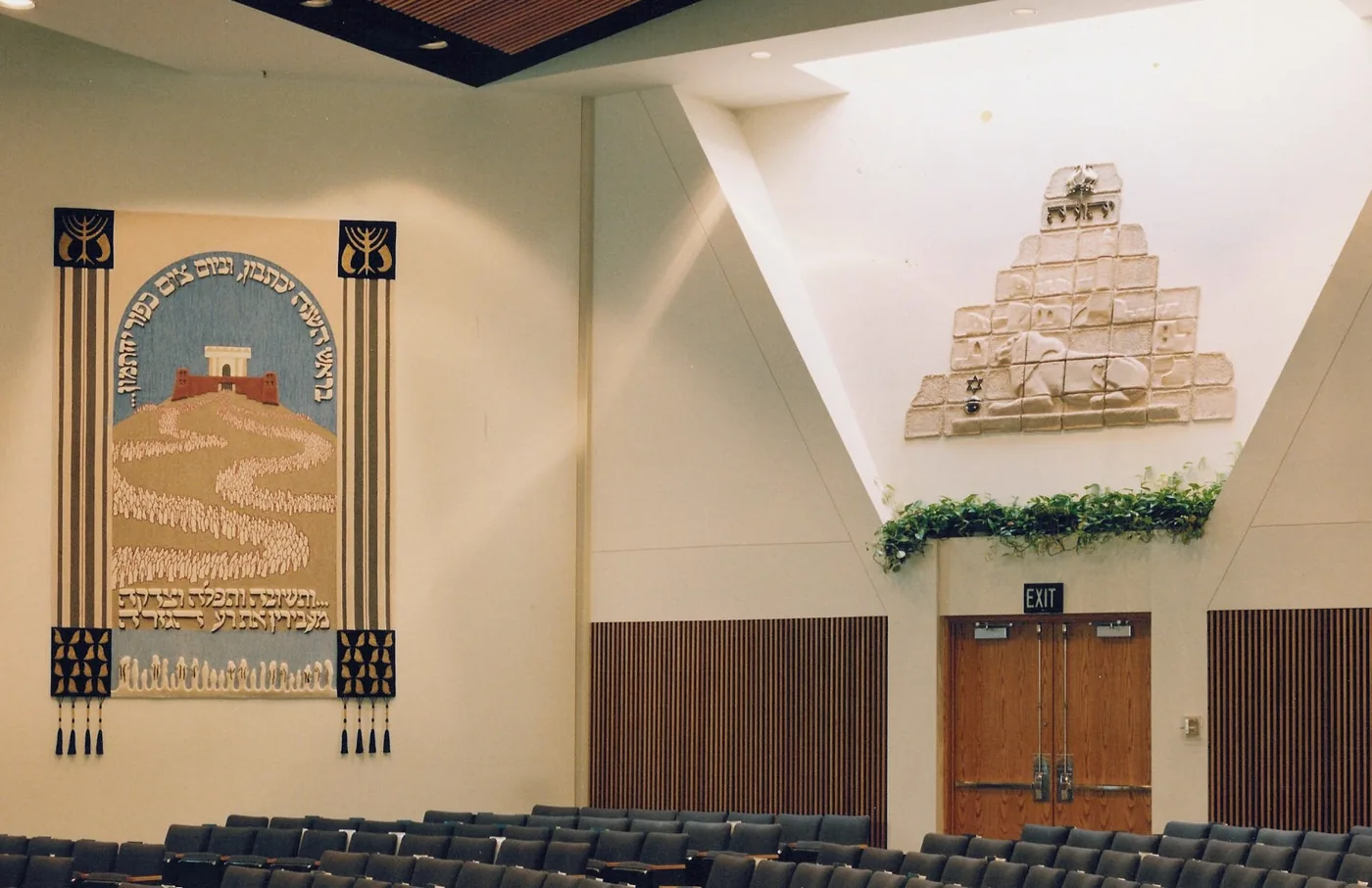
Synagogue and home share the shaping of the Sabbath and Jewish festivals. Among the Torah-mandated festivals—Rosh HaShanah, Yom Kippur, Passover, Shavuot, and Sukkot—Rosh HaShanah, Yom Kippur, and Shavuot tend toward an emphatic synagogue focus, encompassing the congregation as one. Among the artworks embellishing the walls of the Kehilath Israel sanctuary in Overland Park, Kansas, are two enormous (10 x 14’) wool tapestries from 1990 flanking the doors into the space. They represent the High Holidays. Both tapestries are composed with “frames” suggesting a pair of columns—the two columns, Yakhin and Boaz, that stood before the Jerusalem Temple (as referenced in I Kings 7)—but with the images of four-fold fringes, such as those on the tallit, at the bottom of each “column,” and a seven-branched menorah and a pair of shofarot (ram’s horns blown during the High Holidays) at the top of each of them. In recalling the menorah as the central ceremonial element in the Temple, late ancient synagogues in and beyond Judaea-Palestine like that at Bet Alpha typically offered a pair of them, connoting the First and second Temples—or the destroyed Temple of the past and the rebuilt Temple of the messianic future—together with shofarot and other Temple implements in their mosaic floor decors.
The Rosh HaShanah tapestry depicts a row of figures in white—a congregation in prayer—along its lower register, and above that line a stylized sandy mountain from which a semi-abstract flame soars upward. Across the image, in Hebrew, the thirteen aspects of God’s mercy are inscribed as they are spelled out by Maimonides and repeated during the morning service.
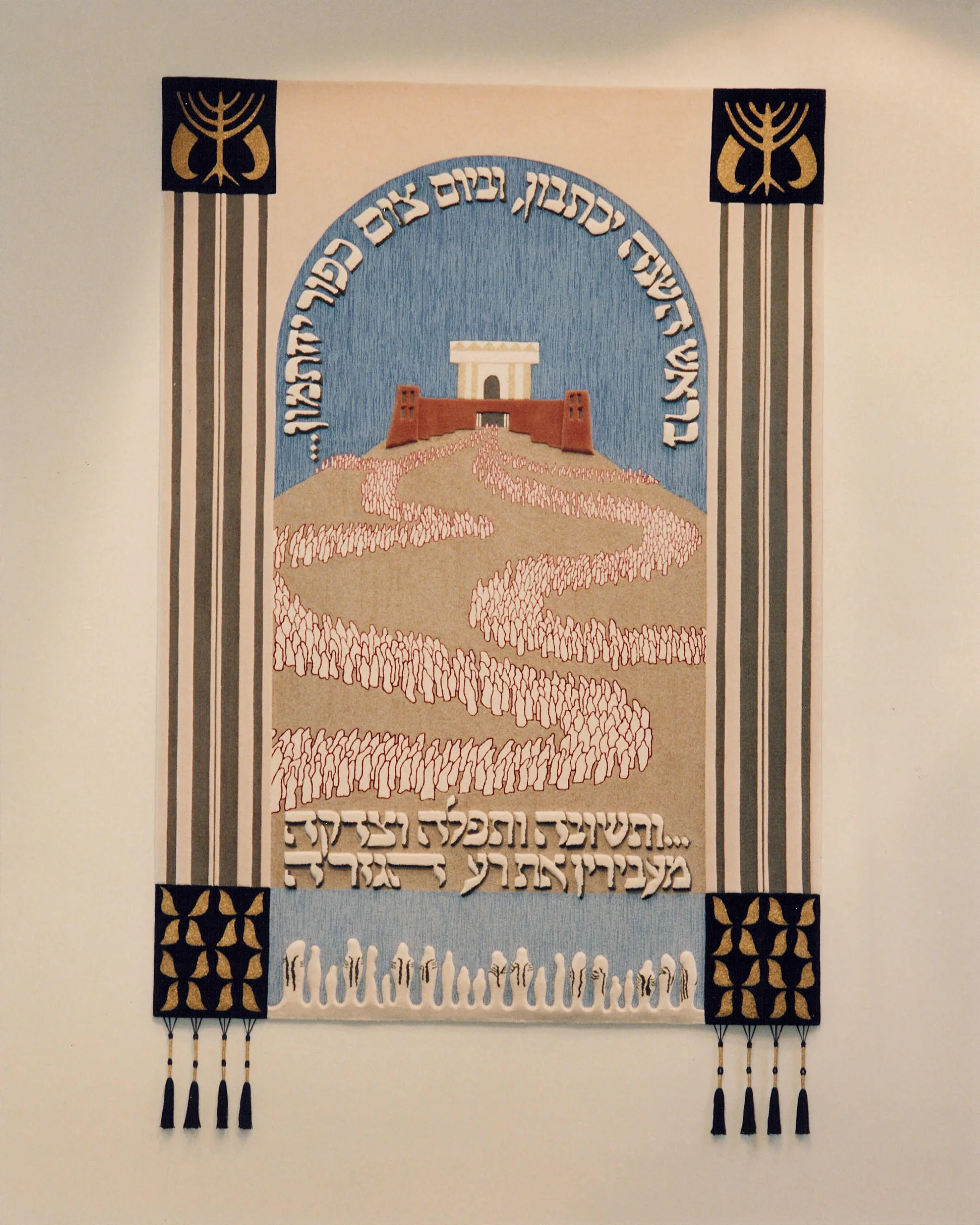
The Yom Kippur tapestry includes the text “…but repentance, prayer and mitzvot avert a harsh decree…” just above the row of praying figures—derived from the Yom Kippur service and alluding to the idea that on this day, the culmination of 10 Days of Awe, God sets down the fate of every individual for the year to come, and the decree can be gentle or harsh, depending upon what one’s behavior has merited. The main subject offers a long double snake of figures in white making their way up to the Temple, and above the scene a second quotation from the liturgy is offered in Hebrew: “on Rosh HaShanah [God] writes it all down and on the Day of Atonement Fast He seals it”.
The Torah-decreed festivals of Passover, Shavuot, and Sukkot eventuate as festivals of pilgrimage to Jerusalem to make offerings at its Temple. Of the three, the one that ends up most firmly implanted in the synagogue, with its emphasis on the Torah and its communal embrace at Sinai, (as opposed to offering significant ceremonial aspects at home) is Shavuot—meaning “Weeks.” Aside from the Torah scrolls themselves, the most obvious ceremonial object that develops over time is the calendar that tracks the time—seven weeks—from the second day of Passover until the beginning of Shavuot. Far from the mood—to say naught of the medium—of the High Holiday hangings is the diverse series of Omer Counters created by Schwarzbart over the years.
The Omer Counter derives its name and symbolic purpose from the idea that on each of these days, a small portion of barley—called an omer—was brought by each member of the community to the Temple. So the Omer Counter, in counting the days, counts the offerings that lead in a steady stream of thanksgiving to God—from the passage through the Sea of Reeds to the reception of God’s Laws at Sinai. Schwarzbart’s Omer Counters also demonstrate a principle increasingly common in contemporary Judaica, of blurring ceremonial object and fine art.
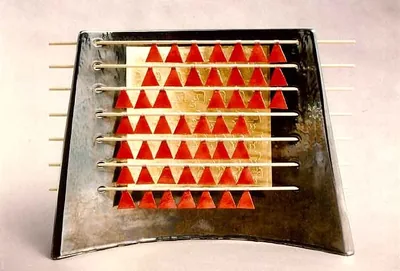
To the untutored eye, his 1997 14” h by 18” w slightly curved clay work with a repousse gold panel placed across its anterior surface—through which 7 bronze rods pass, each hung with seven small copper triangles—would surely present itself as an attractive abstract table sculpture. Its function, however, becomes clear from its details: it is divided into seven sevens—the triangles on the bronze rods are shifted, one each day, from side to side—and its gold is embossed with 49 pairs of Hebrew letters associated with the kabbalistic spherot (the ten “aspects” of Godness but also of human connectedness to God, with specific conceptual/spiritual separation between the “lower” seven and the “upper” three) as a reminder of the obligation for the Jewish mystic to meditate on each of those days as s/he prepares him/herself for the Sinai moment. Thus the work—a distinctive multi-media semi-abstract sculpture called “The Time ‘Til Sinai”—is a functional Omer Counter.
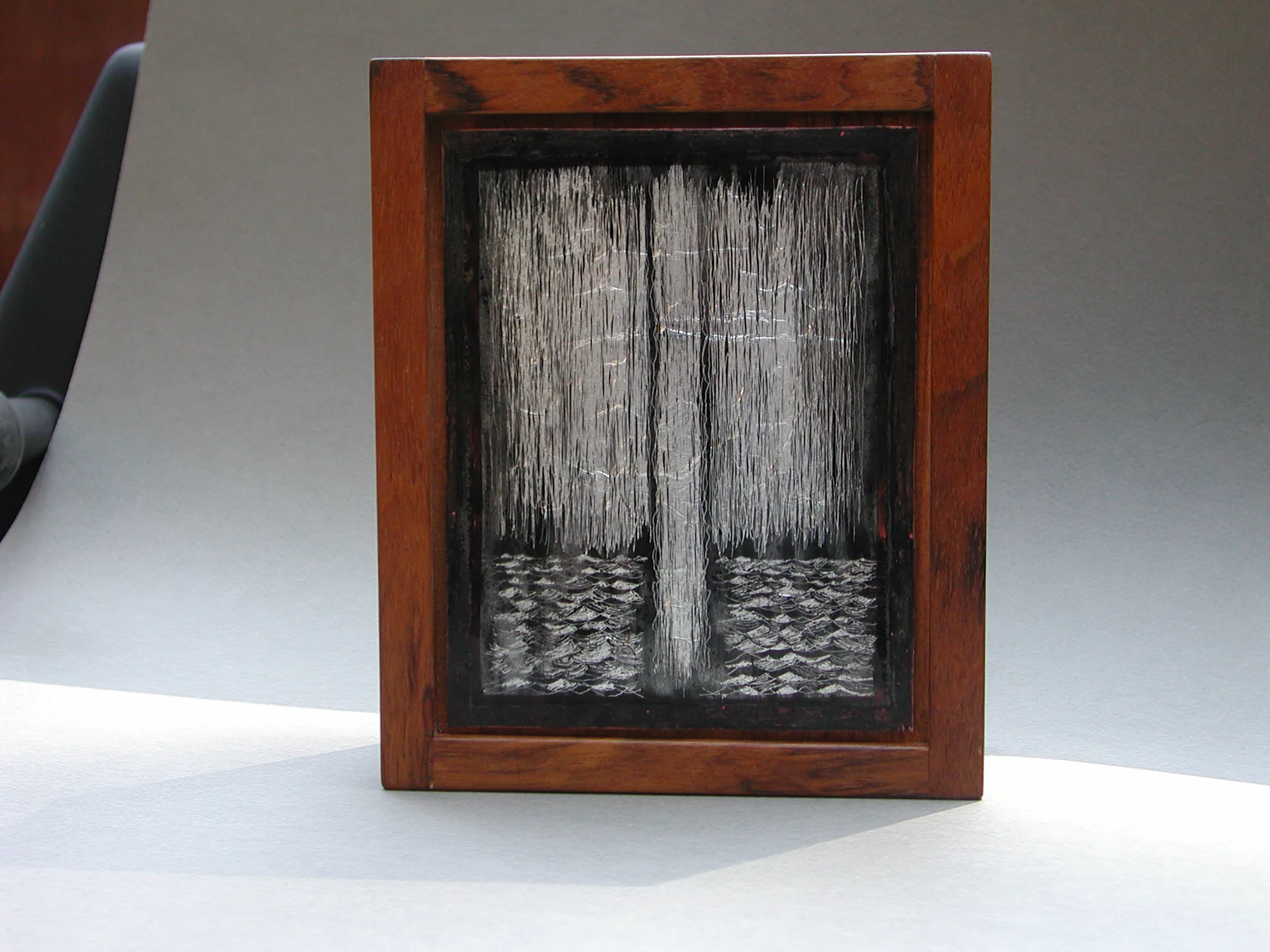
A second Omer Counter, from 2001—and intended specifically to be usable while travelling (thus wherever one finds oneself, one’s home and synagogue are with one, as one counts and meditates)—is also “named.” “The Face of the Waters” is a small (7” x 5” x 2”) teak box the front panel of which is an enamel-on-copper drawing. The image suggests water below and a vertically depicted sky—as if a heavy rain is plunging toward the sea. The center of that vertical configuration pushes into the Sea, in fact, separating its two sides: it is at once the Sea of Reeds being parted and the instrument of separation, a pillar, is a reference to the pillar of smoke by day and fire by night (Ex 13:21) that will lead the Israelites through the wilderness from Sinai to the Promised Land, hovering 24/7 over the Tabernacle to connote God’s eternal Presence (shekhinah) among them.
One opens this box and within it are two panels of light maple wood into which the imagery has been burned, which face each other from the two sides. To the left the traditional image of the spherot is depicted. To the right are the 49 letter-pairs focused on the spherot—and the blessing that explains the word-play yielding the kabbalist’s obligation to focus on them on the path from Passover to Shavuot. The words are: “Blessed art Thou, O Lord our God, Ruler of the universe, who has sanctified us by His commandments (miztvot) and commanded us regarding the counting (spherot) of the Omer.” For in common Hebrew parlance, “counting” is spherot—thus the kabbalist counts the Omer by meditating on the spherot as aspects of God and human-divine connection, but which may also simply be called “countings.”
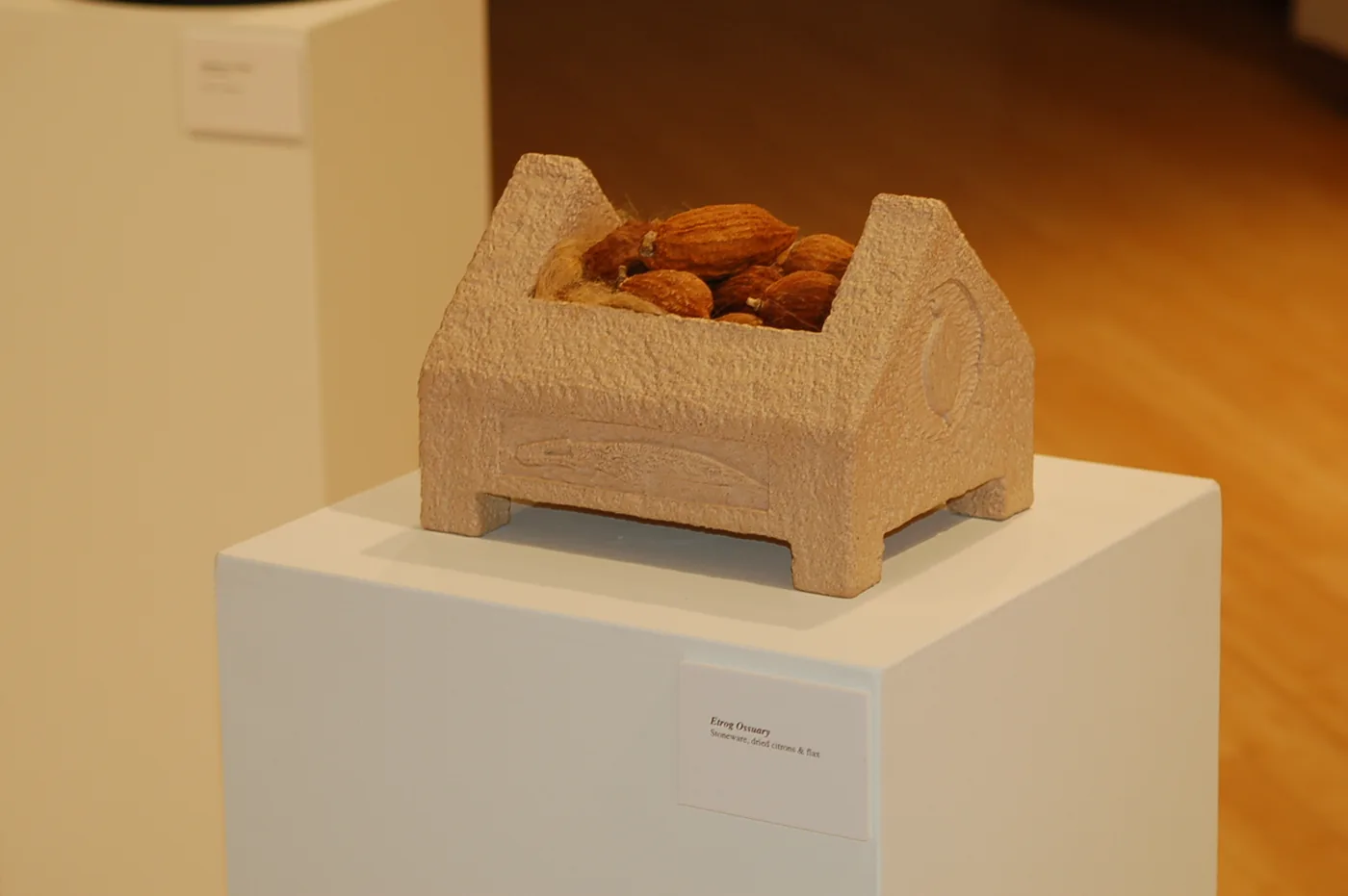
Among the Torah-mandated festivals, Passover and Sukkot place a particularly strong emphasis on home celebration and also offer the widest range of visual accompaniments to those home-centered events—from the illumination of the Passover haggadah and the shaping of ceremonial objects to festoon the Seder table to the unique decoration of the sukkah. One of the more imaginative pieces made by Schwarzbart that reflects this home emphasis—but also the unique way in which aspects of the Jewish home connect to the synagogue in extending sacred space—is an etrog container. This is not the standard-issue ceremonial object to be used to hold the citron that comprises one fourth of the plant life used for symbolic purposes across that 8-day-long holiday. The 7”h x 10”w x 71/2”d 1994 stone box is designed like a miniature sarcophagus, its surface embellished with images of the six-pointed star and the lulav. It reflects the tradition that one keeps the etrog after the festival has ended, and may collect them over the years. So this is a kind of ossuary (a container for bones): an “Etrog Ossuary” for the “dried bones” of past Sukkot celebrations.
The more minor holiday of Purim—the text for which was the last to be accepted into the biblical canon—emphasizes communal celebration within the synagogue and out into the streets. Still more minor—but over the last century or two, increasingly popular, especially in the United states—the festival of Hanukkah (its textual basis, the Books of Maccabees, outside the Hebrew Bible altogether), in the depths of winter, and offering certain parallels to the Christian celebration of Christmas, has a decided home emphasis and a particularly beautiful visual manifestation over the centuries: the hanukkiyyah.
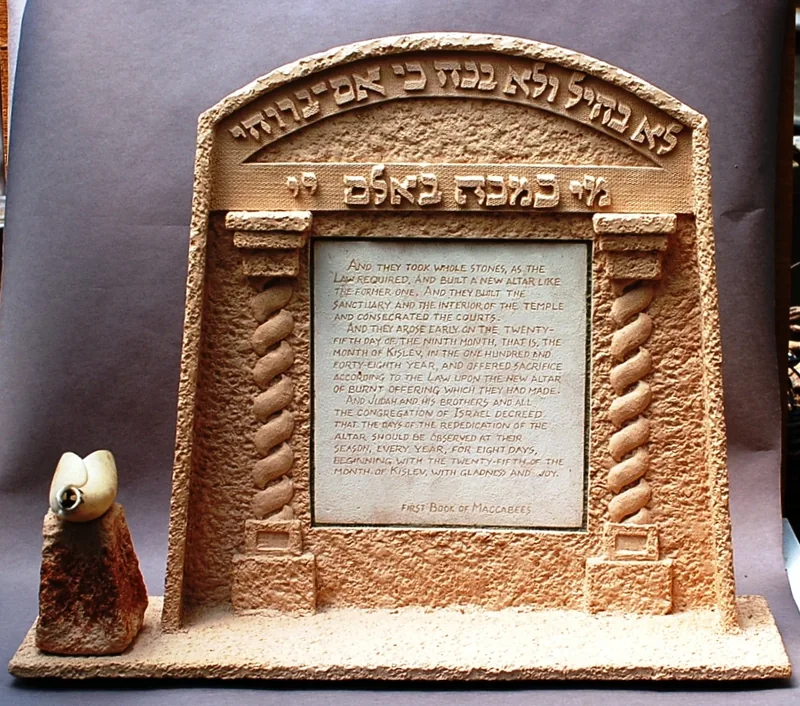
A “cross-purpose” artistic principle similar to his Omer Counters applies to the fabrication of a 19” high x 21” wide oil-lamp Hanukkah Menorah that Schwarzbart designed in 1994. He has treated this hanukkiyyah as a sculpture, with a title—“Maccabean Stele”—for he has used the more traditional medieval type, with oil lamps along the bottom, and a large arched back plate that affords its own decorative possibilities as its own art form. The back plate is re-considered as the sort of stele that, the artist imagined, the Maccabees might have set up to commemorate their victory over the Seleucids, the rededication of the Temple, and the rekindling of its seven-branched menorah.
He emulates what he playfully speculates might have been their materials—cut stone, faced with plaster—using stoneware clay for the structure and porcelain for the lamps, and overruns the back plate with texts. Along the arched upper edge are the words, in Hebrew, from the prophet Zechariah, “not by might, not by power, but by My Spirit”—underscoring the divine role in the miraculous Hanukkah story (as it is conveyed in II Maccabees, in particular)—with a pair of shofarot just below them. Along a horizontal line just below the shofarot is a second inscription in Hebrew—“Who Is Like You Among the Gods, Oh Lord?”—from Moses’ song of praise to God after the Sea of Reeds crossing, in Ex 15:1. The combination of the first consonant in each of the words in Hebrew—MCBI—creates an acrostic: maccabi.
Below this pair of inscriptions, two low-relief-carved pilasters extend down to the base, suggesting the two columns before the Temple in Jerusalem. They frame a white porcelain panel on which three passages from the Books of Maccabees—that speak of the rededication of the Temple (hanukkat haBayit)—are inscribed in English. Schwarzbart used English, the vernacular, based on his conviction that the Maccabean stele would have been inscribed in the vernacular—perhaps, he suggests, Aramaic (rather than Hebrew). Thus even at a linguistic level, this ritual object and work of art serves as a bridge between sacred and profane ways of thinking and being in the world, as its place of use comfortably shuttles back and forth between synagogue sanctuary and home window ledge, and has come to be kindled in public squares in diverse parts of today’s America.
4 The House of God Beyond Everyday Sacred Time and Space
Let us twist the account of Schwarzbart’s art’s relationship to outwardly extending sacred synagogue spaces one more turn, with a 2008 work devoted to “Divine Doodles.” This work—that would find its most logical place to one side of the Holy Ark, in visual counterpoint to the image of the seven-branched candelabrum that often stands (or in Schwarzbart’s case, adheres to the wall) to the other side—addresses the question of what took place before the words “In the beginning…” that open the Torah: the sort of question that Jewish mystics twist their brains trying to answer. One of the responses in the central kabbalistic text, the early 14th-century Zohar (“[Book of] Splendor/Brilliance”) notes how the Divine Light (a small bit of which will suffuse primordial reality when God says “Let there be light!”) is attenuated by God so that humans will not be blinded by it or subsumed into the Oneness of God.
That bit of light, however, within the Zoharic discussion, expands a space for itself: like a silkworm, building its own house that evolves into a palace from which emanate the ten spherot, which are the instruments through which the universe—four levels of created space (“emanation,” “creatio ex nihilo,” “formation,” and “making”; these also correspond to the four letters of God’s ineffable Name)—are created and maintained. The “highest” of these spherot, keter (“crown”) is closest to the spiritual realm of God and the lowest, malkhut (“kingdom”), is closest to our physical reality.
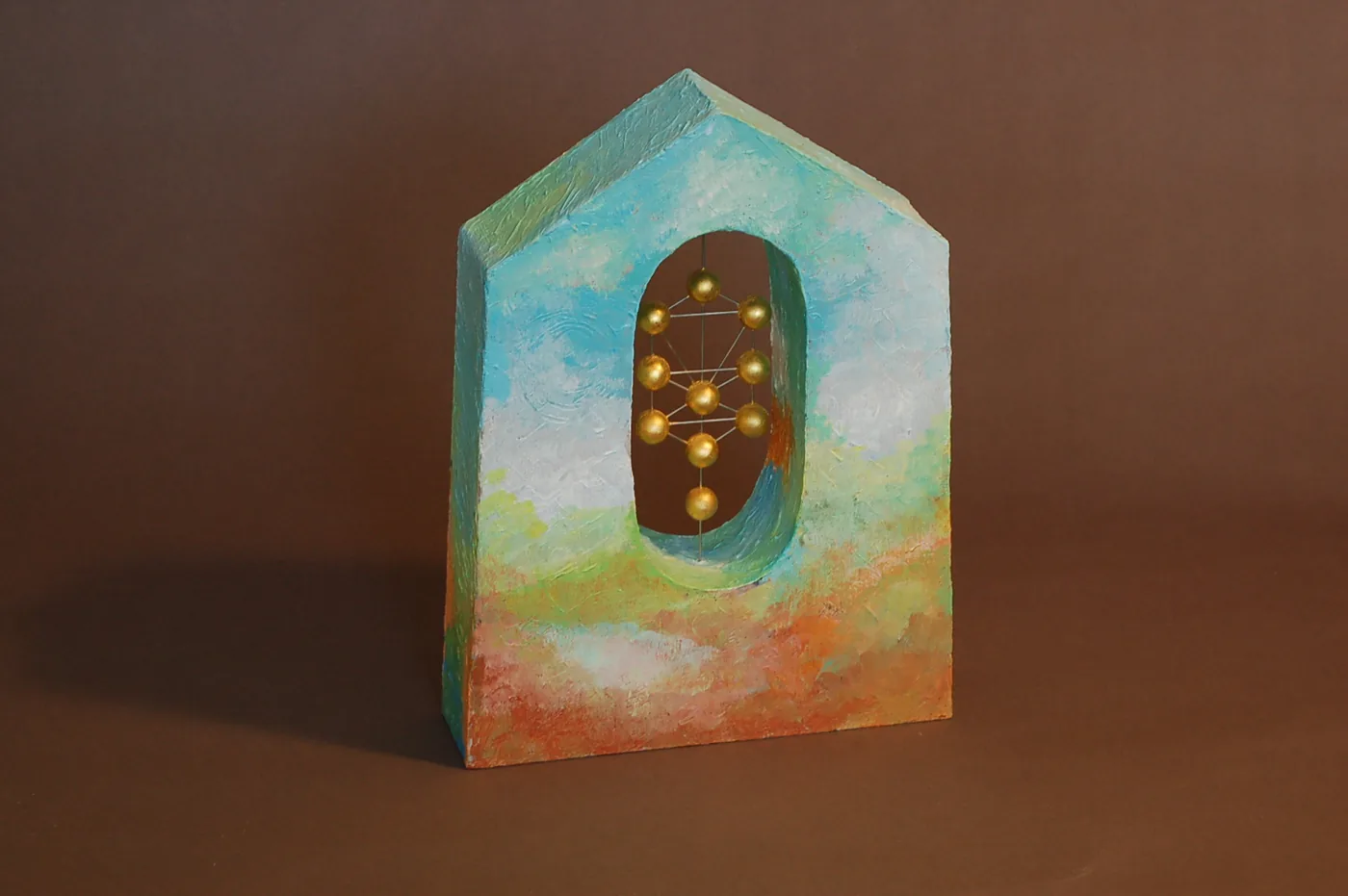
Schwarzbart created a stylized house, shape of fired and burnt-glazed clay, in which he drew and incised a range of kabbalistically-inspired drawings—doodles of sorts—that play with the Hebrew letters of God’s ineffable Name in infinitizing permutations, and with Hebrew letters generally—referred to as conduits of creation in the early Jewish mystical text, the “Book of Formation” (Sepher Yetzirah). Geometric formations allude to the directions of physical space: up-down, east-west, north-south; and a series of tight concentric circles references the increasing attenuation of the primordial light. The “house” form—the “light cocoon,” but also a metaphor for the synagogue as “God’s House”—is flat and its center open, the void filled by ten small gold spheres suspended on wires in the familiar configuration of the spherot. The invisible God and the visible creation are blurred in a series of abstract ideas become an abstract sculpture sacralizing the space within and around it.
Somewhat more obscure—intentionally, given its mysticism-related intentions—is a cylinder with a traditional Hebrew meditation text and a wooden base by Ernie Gross, acquired in 2016 by the Knoxville Museum of Art. Its shape is inspired by a cylinder inscribed in Persian cuneiform which the artist saw at the Jewish Museum in New York—upon which the 539 BCE Decree of Return by Cyrus II “the Great” is engraved—and also by the Talmudic comment (Pirke Avot 5:22), that “Ben Bag used to say, regarding Torah study: ‘Turn it, and turn it, for everything is in it…’.” Schwarzbart’s cylinder offers the first portion of a complex kabbalistic meditation. It is a combination of the letter aleph with each of the letters of the Tetragrammaton (YHVH), and each pair of letters is inscribed and intended to be pronounced with every possible combination of vowels. If one were able to pronounce four of these two-letter syllables every second, it would take about seven hours to complete the meditation—and surely one would achieve an ecstasy that placed one before the Heavenly Throne!
The ever-evolving vocabulary of the décor within and beyond the sanctuary over time and space has included an ever-expanding array of subjects and topics that, drawn into synagogue and also home spaces, re-enforce the quality and shape of their sacredness. The resultant objects re-affirm the synagogue and its concomitants’ centrality to the task of connecting Jews to the God beyond space and time and to each other, as individuals who interlock as congregations and communities. Arnold Schwarzbart was among those uniquely gifted individuals with the talent and energy to provide unusual and beautiful visual instruments for fulfilling that task, in a career that often blurred medium and concept in linking synagogue and home and beautifying both sacred and profane realms.
Ori Z. Soltes
Georgetown University
Notes
- I wish to express my thanks to Mary Linda Schwarzbart, for suggesting that I propose this article to Arts, and for providing immeasurable assistance with regard to the dates and circumstances of so many of Arnold’s pieces. ↩
- For a fuller discussion of all of these issues, see Ori Z Soltes, Modern Jewish Art: Definitions, Problems, and Opportunities. ↩
- Biographical details come from conversations with the artist, from 1995until 2013, and subsequently, after his death in 2015, through email correspondence with his widow, Mary Linda. My own writing on Schwarzbart’s work began when he was part of an exhibition that I curated on Jewish ceremonial objects in August-October, 1997 at the B’nai B’rith Klutznick National Jewish Museum. At that time, I focused only briefly on the Omer Counter (see below, Fig 12), Etrog Ossuary (see below, Fig 14) and hanukkiyyah (see below, Fig 15) that he contributed to the exhibition. I subsequently wrote a bit more, but discussing only that same Omer Counter, in my volume, Tradition and Transformation: Three Millennia of Jewish Art & Architecture. The formal bibliography on Schwarzbart overall is rather slim—mainly confined to frequent coverage of his work in the local Knoxville and broader Tennessee press, and occasional mentions in articles in the popular press in other parts of the country—often in locations where his work had recently appeared. As his widow observed in an email to me, (June 4, 2019): “We did not ‘go after’ broad coverage of his work. Our local papers wrote about Arnold many times, almost to his embarrassment.” Part of my intention in composing this article is to bring his work to a wider audience. ↩
- Ernie Gross is an extremely accomplished designer and artist in wood; he produces religious objects as well as everyday objects, small and very large, for residential and commercial clients. One of his more significant projects was the design and fabrication of the Schwarzbart Gallery, created in honor and memory of Arnold at the Arnstein Community Center in Knoxville, ↩
- As often happens with an artist who assimilates a range of influences and transforms them into his own visions, Schwarzbart apparently misremembered one key detail in this case—namely: in his website description he refers to having been “inspired by a 17th-century pair of Ark doors.” Regarding the actual source of inspiration for the ark doors, Mary Linda wrote (in the previously-mentioned June 4, 2019 email): “The ark was inspired by an image on a postcard (which I cannot find) given to him by our dear friend, Dr Gilya Schmidt (Professor Emerita of Religious Studies, Director Emerita, The Fern and Manfred Steinfeld Program in Judaic Studies, University of Tennessee, Knoxville)… The image is of a painted ark in a Polish synagogue, painted in the traditional style of Polish folk art… [Arnold’s] ark was originally designed to be painted. The donor wanted it carved.” He may, in fact, also have been influenced by the Polish ark doors that belonged to the so-called Butzian synagogue in Krakow, which were both carved and painted with the four-animal motif—and in any case the carver of the German doors was originally from Poland. For, regarding the image on the postcard, Dr. Schmidt contributed the following details from an unpublished paper that may become part of a book on which she is working: “[In a] house… owned by Moses Seligmann Mayer… [i]n 1738 Eliezer Sussmann, originally from Brod, Poland, painted an upstairs room, clearly for the purpose of worship. All of the texts are for congregational unison prayer. We do not know what the original arrangement looked like. Unfortunately, soon after its completion, in 1744, Moses died. His heirs got into financial difficulties and were forced to sell the house to a Christian buyer in 1788 (Andreas Maisch, Mayer Seligmann, Judt zu Unterlimpurg. Schwaebisch Hall: Stadtarchiv und Hohenloher Druck- und Verlagshaus, 2001, pp. 219-220). Thereafter the room was dismantled and the paneling was taken down, board for board, and stored. For over 100 years, no one remembered that it existed. Only in 1904 was it mentioned by a Jewish teacher in a lecture. In 1907 the local historical society bought the panels for 525 Marks. The panels are now in the possession of the district of Franken and have been installed several times in different museums. Currently they are on display in the Fraenkische Museum in Schwaebisch Hall.” ↩
- The notion of the four animals as a metaphor for the Tetragrammaton was communicated to me by Schwarzbart in a conversation in May, 1999. Recently, in responding to my question about this, Mary Linda responded (in the above- referenced email of June 4, 2019), that “Arnold was well-read in Jewish mysticism… [he] had an amazing ability to remember what he had read. He absorbed it all and it influenced his design concepts, providing a deeper meaning for almost everything he created.” ↩
- Both references and images for pieces for which space does not permit images here may be found on the Arnold Schwarzbart website. ↩
- See Maimonides’ discussion of eight levels of tz’dakah, from helping someone by offering the means with which he can ultimately help himself and no longer be dependent on tz’dakah, down to giving inadequately and unwillingly (Mishneh Torah, “Laws of Tz’dakah,” 10-:7-14”). ↩
- This intended contrastive visual reference is made clear on the artist’s website. ↩
- For an elaboration of this idea, see Abraham Joshua Heschel’s iconic 1951 work, The Sabbath. There have been many different editions; among the most recent, that published by Farrar, Straus and Giroux (who brought out the original edition, as well), in 2005 with an introduction by Susannah Heschel. ↩
Bibliography
Selected sources, including in the popular press, in which Schwarzbart's work is discussed briefly or more extensively.
- Atlanta Jewish Times, The, April l6, 1990; October 28, 2002
- Chronicle, HUC-JIR, 2001
- Cleveland Jewish News, March 15, 1996
- Edwards, Lauton, Industrial Arts Plastics, (NY: C. A. Bennett Co; 1964)
- Hermachandra, Ray & Daniel Belasco, 500 Judaica: Innovative Contemporary Ritual Art, (Asheville, NC: Lark Books, 2010
- Jewish Press Magazine, The, March 29, 2002
- Knoxville Journal, December,19888; August 9,1989
- Knoxville Mercury: “R.I.P. Arnold Schwarzbart,” March 25, 2015
- Knoxville News-Sentinel, The, November 6, 1994; December, 1986; ”History & Function: UT exhibit ‘Judaica’ reflects former architect’s faith, family,” July 26, 2008; “New gallery at Arnstein Center honors artist Arnold Schwarzbart “January 31, 2016
- Marks Project, The: https://www.themarksproject.org/marks/schwartzbart-zl
- Moment Magazine, November,1983; December, 1984
- Morton, Kathryn, Judaic Artisans Today: Contemporary Judaica in the United States and the Artists Who Created It, (Gaithersburg, MD: Flower Valley Press, 1999)
- National Jewish Post & Opinion, The, November 21, 2007
- New York Daily News, December, 1966
- _________________, Passover Supplement, March, 1985
- Object Lessons: Beauty and Meaning in Art, (Cincinnati: Northlight Books; 2001)
- Rosenbaum, Belle, Upon Thy Doorposts: The Law, the Lore, the Love of Mezzuzot: a Personal Collection, (NY: Jacob and Belle Rosenbaum Fdn,1995
- Soltes, Ori Z, “Memory, Questions, and Definitions: Images of Old and New Rites of Passage,” in Leonard J, Greenspoon, ed., Rites of Passage: How Today’s Jews Celebrate, Commemorate, and Commiserate, (West Lafayette, IN: Purdue University Press, 2010
- __________, Modern Jewish Art: Definitions, Problems, and Opportunities (Leiden: Brill, 2019)
- __________, Realm Between Realms (Exhibition catalogue) (Washington, DC: B’nai B’rith Klutznick National Jewish Museum, Aug-Oct,1997).
- __________, Tradition and Transformation: Three Millennia of Jewish Art & Architecture (Boulder: Canal Street Studios, 2016)
- Tupa, Rockland, Mae, The Hanukkah Book (New York: Schocken Books, 1975)
- _________________, The New Work of Our Hands: Contemporary Jewish Needlework & Quilts, (Darby, PA: Diane Publishing Co, 1994
- Washington Home, December, 1989
Reproduced in full from the author's typescript, with his figure callouts illustrated from the studio's photographs. Text © Ori Z. Soltes. Photographs © Arnold Schwarzbart and family.