Press and Video

Video

Six recordings, from Mary Linda Schwarzbart's YouTube channel.

1989 Tennessee This Morning. A television visit to the studio in the year of his first one-person show.
1999 HGTV, Modern Masters holiday special. Arnold shaping the Maccabean Stele and throwing its oil lamps, filmed at the studio by High Noon Productions. It ran on HGTV for several Decembers.
2000 CTV, with Beth Waters. An interview from June 2000.
2001 East Tennessee Holocaust Conference. Arnold as storyteller, "Degradation to Redemption," April 1, 2001.
2008 Live at 5, UT Downtown Gallery. On the opening of "Reflections of the Other."
2014 Temple Beth El, Knoxville. Arnold at the opening of his exhibit at Temple Beth El, filmed by Wendy Besmann.

Clippings

Three Knoxville News-Sentinel pages from the architecture years, on the Knoxville Zoo that GSW designed. Click a clipping to read it.
Newspaper clipping: Animals' Comfort Is New Zoo's Emphasis
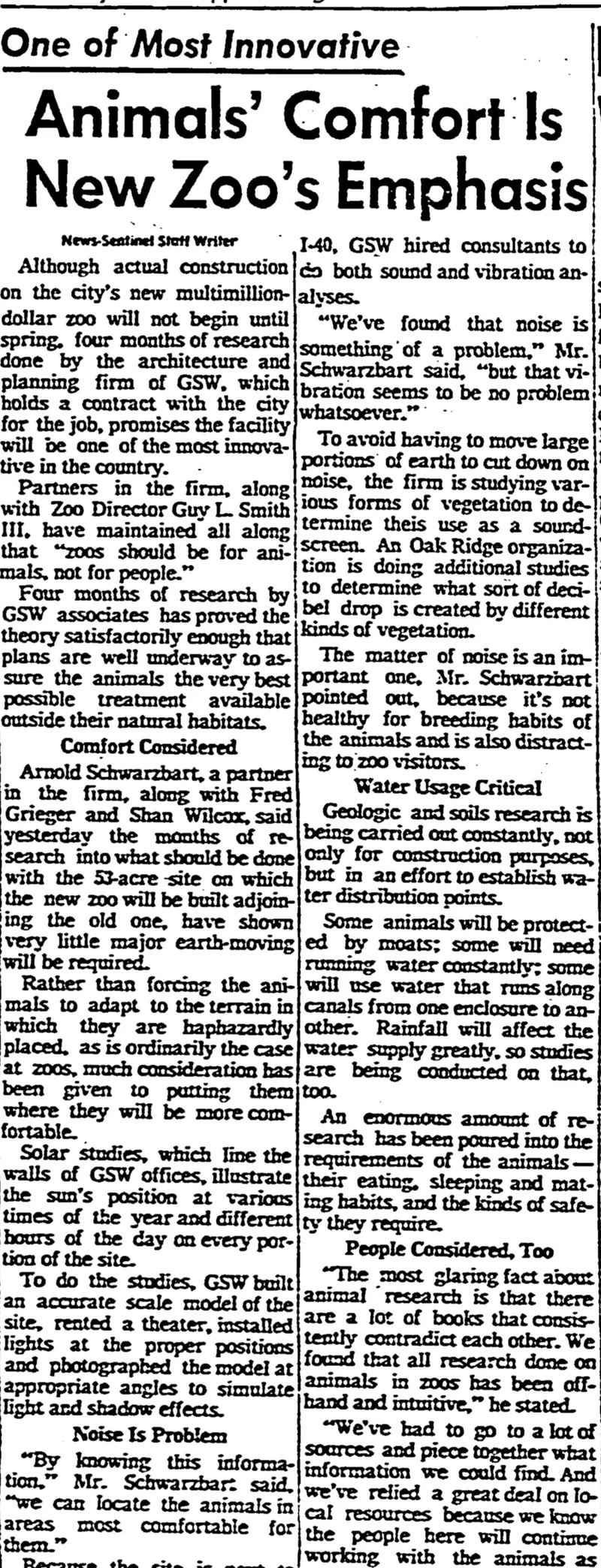
January 11, 1973 "Animals' Comfort Is New Zoo's Emphasis," Knoxville News-Sentinel. On the four months of research GSW put into the new Knoxville Zoo before construction: solar studies on a scale model, sound and vibration consultants, soils and water surveys. Arnold, quoted throughout, on the state of the field: "all research done on animals in zoos has been offhand and intuitive." The firm's rule was that zoos should be for animals, not for people.

One of Most Innovative

Animals' Comfort Is New Zoo's Emphasis

Although actual construction on the city's new multimillion-dollar zoo will not begin until spring, four months of research done by the architecture and planning firm of GSW, which holds a contract with the city for the job, promises the facility will be one of the most innovative in the country.

Partners in the firm, along with Zoo Director Guy L. Smith III, have maintained all along that "zoos should be for animals, not for people."

Four months of research by GSW associates has proved the theory satisfactorily enough that plans are well underway to assure the animals the very best possible treatment available outside their natural habitats.

Comfort Considered

Arnold Schwarzbart, a partner in the firm, along with Fred Grieger and Shan Wilcox, said yesterday the months of research into what should be done with the 53-acre site on which the new zoo will be built adjoining the old one, have shown very little major earth-moving will be required.

Rather than forcing the animals to adapt to the terrain in which they are haphazardly placed, as is ordinarily the case at zoos, much consideration has been given to putting them where they will be more comfortable.

Solar studies, which line the walls of GSW offices, illustrate the sun's position at various times of the year and different hours of the day on every portion of the site.

To do the studies, GSW built an accurate scale model of the site, rented a theater, installed lights at the proper positions and photographed the model at appropriate angles to simulate light and shadow effects.

Noise Is Problem

"By knowing this information," Mr. Schwarzbart said, "we can locate the animals in areas most comfortable for them."

Because the site is next to I-40, GSW hired consultants to do both sound and vibration analyses.

"We've found that noise is something of a problem," Mr. Schwarzbart said, "but that vibration seems to be no problem whatsoever."

To avoid having to move large portions of earth to cut down on noise, the firm is studying various forms of vegetation to determine their use as a sound-screen. An Oak Ridge organization is doing additional studies to determine what sort of decibel drop is created by different kinds of vegetation.

The matter of noise is an important one, Mr. Schwarzbart pointed out, because it's not healthy for breeding habits of the animals and is also distracting to zoo visitors.

Water Usage Critical

Geologic and soils research is being carried out constantly, not only for construction purposes, but in an effort to establish water distribution points.

Some animals will be protected by moats; some will need running water constantly; some will use water that runs along canals from one enclosure to another. Rainfall will affect the water supply greatly, so studies are being conducted on that, too.

An enormous amount of research has been poured into the requirements of the animals, their eating, sleeping and mating habits, and the kinds of safety they require.

People Considered, Too

"The most glaring fact about animal research is that there are a lot of books that consistently contradict each other. We found that all research done on animals in zoos has been offhand and intuitive," he stated.

"We've had to go to a lot of sources and piece together what information we could find. And we've relied a great deal on local resources because we know the people here will continue working with the animals as..."

[The article continues beyond the edge of the clipping.]

Newspaper clipping: Knoxville Zoo's Reptile Curator Got First Job Because Nobody Wanted It
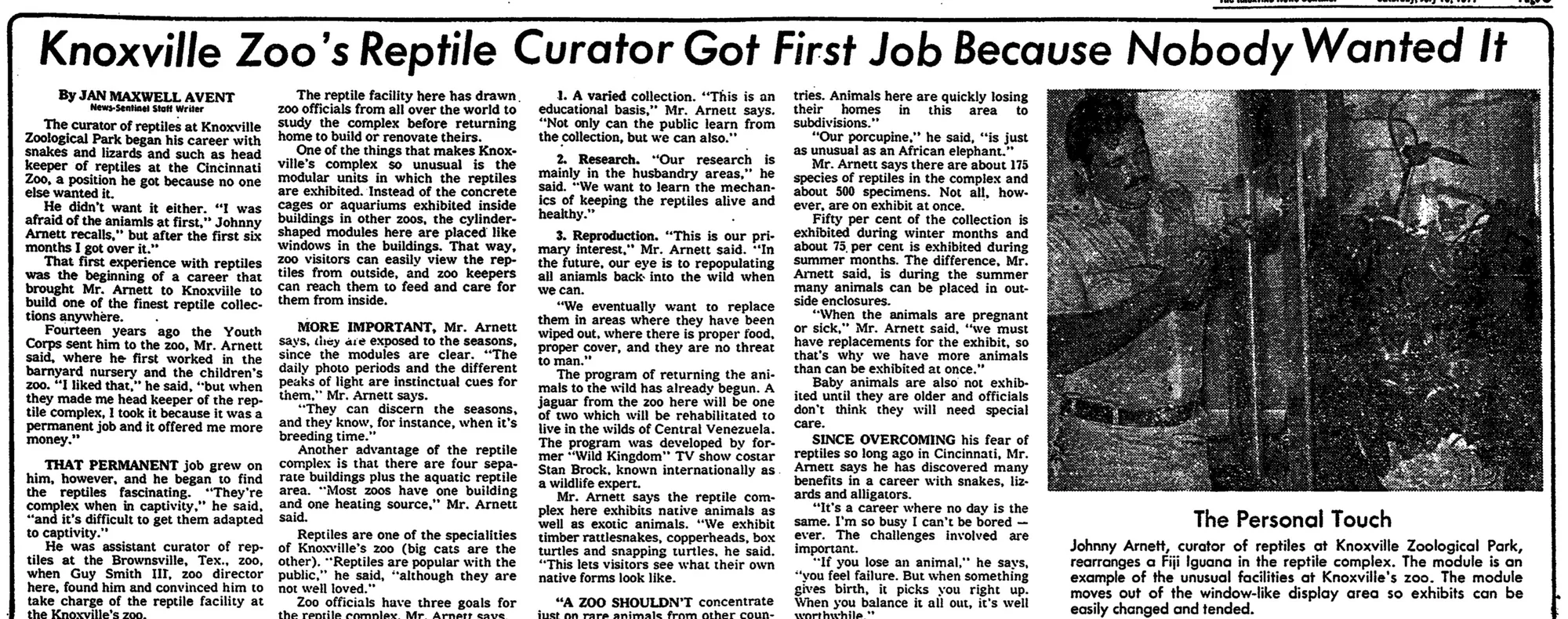
July 16, 1977 Jan Maxwell Avent, "Knoxville Zoo's Reptile Curator Got First Job Because Nobody Wanted It," Knoxville News-Sentinel. A profile of curator Johnny Arnett that describes the reptile complex Arnold designed: cylinder-shaped modules set like windows in the buildings, so that visitors look in from outside, keepers work from inside, and the animals feel the seasons. Zoo officials from around the world came to study it before building their own.

Knoxville Zoo's Reptile Curator Got First Job Because Nobody Wanted It

The curator of reptiles at Knoxville Zoological Park began his career with snakes and lizards and such as head keeper of reptiles at the Cincinnati Zoo, a position he got because no one else wanted it.

He didn't want it either. "I was afraid of the animals at first," Johnny Arnett recalls, "but after the first six months I got over it."

That first experience with reptiles was the beginning of a career that brought Mr. Arnett to Knoxville to build one of the finest reptile collections anywhere.

Fourteen years ago the Youth Corps sent him to the zoo, Mr. Arnett said, where he first worked in the barnyard nursery and the children's zoo. "I liked that," he said, "but when they made me head keeper of the reptile complex, I took it because it was a permanent job and it offered me more money."

That permanent job grew on him, however, and he began to find the reptiles fascinating. "They're complex when in captivity," he said, "and it's difficult to get them adapted to captivity."

He was assistant curator of reptiles at the Brownsville, Tex., zoo, when Guy Smith III, zoo director here, found him and convinced him to take charge of the reptile facility at Knoxville's zoo.

The reptile facility here has drawn zoo officials from all over the world to study the complex before returning home to build or renovate theirs.

One of the things that makes Knoxville's complex so unusual is the modular units in which the reptiles are exhibited. Instead of the concrete cages or aquariums exhibited inside buildings in other zoos, the cylinder-shaped modules here are placed like windows in the buildings. That way, zoo visitors can easily view the reptiles from outside, and zoo keepers can reach them to feed and care for them from inside.

More important, Mr. Arnett says, they are exposed to the seasons, since the modules are clear. "The daily photo periods and the different peaks of light are instinctual cues for them," Mr. Arnett says.

"They can discern the seasons, and they know, for instance, when it's breeding time."

Another advantage of the reptile complex is that there are four separate buildings plus the aquatic reptile area. "Most zoos have one building and one heating source," Mr. Arnett said.

Reptiles are one of the specialities of Knoxville's zoo (big cats are the other). "Reptiles are popular with the public," he said, "although they are not well loved."

Zoo officials have three goals for the reptile complex, Mr. Arnett says.

1. A varied collection. "This is an educational basis," Mr. Arnett says. "Not only can the public learn from the collection, but we can also."

2. Research. "Our research is mainly in the husbandry areas," he said. "We want to learn the mechanics of keeping the reptiles alive and healthy."

3. Reproduction. "This is our primary interest," Mr. Arnett said. "In the future, our eye is to repopulating all animals back into the wild when we can."

"We eventually want to replace them in areas where they have been wiped out, where there is proper food, proper cover, and they are no threat to man."

The program of returning the animals to the wild has already begun. A jaguar from the zoo here will be one of two which will be rehabilitated to live in the wilds of Central Venezuela. The program was developed by former "Wild Kingdom" TV show costar Stan Brock, known internationally as a wildlife expert.

Mr. Arnett says the reptile complex here exhibits native animals as well as exotic animals. "We exhibit timber rattlesnakes, copperheads, box turtles and snapping turtles," he said. "This lets visitors see what their own native forms look like."

"A zoo shouldn't concentrate just on rare animals from other countries. Animals here are quickly losing their homes in this area to subdivisions."

"Our porcupine," he said, "is just as unusual as an African elephant."

Mr. Arnett says there are about 175 species of reptiles in the complex and about 500 specimens. Not all, however, are on exhibit at once.

Fifty per cent of the collection is exhibited during winter months and about 75 per cent is exhibited during summer months. The difference, Mr. Arnett said, is during the summer many animals can be placed in outside enclosures.

"When the animals are pregnant or sick," Mr. Arnett said, "we must have replacements for the exhibit, so that's why we have more animals than can be exhibited at once."

Baby animals are also not exhibited until they are older and officials don't think they will need special care.

Since overcoming his fear of reptiles so long ago in Cincinnati, Mr. Arnett says he has discovered many benefits in a career with snakes, lizards and alligators.

"It's a career where no day is the same. I'm so busy I can't be bored, ever. The challenges involved are important."

"If you lose an animal," he says, "you feel failure. But when something gives birth, it picks you right up. When you balance it all out, it's well worthwhile."

Photo caption, The Personal Touch: Johnny Arnett, curator of reptiles at Knoxville Zoological Park, rearranges a Fiji iguana in the reptile complex. The module is an example of the unusual facilities at Knoxville's zoo. The module moves out of the window-like display area so exhibits can be easily changed and tended.

Newspaper clipping: International Center for Breeding Animals Envisioned at Knox Zoo
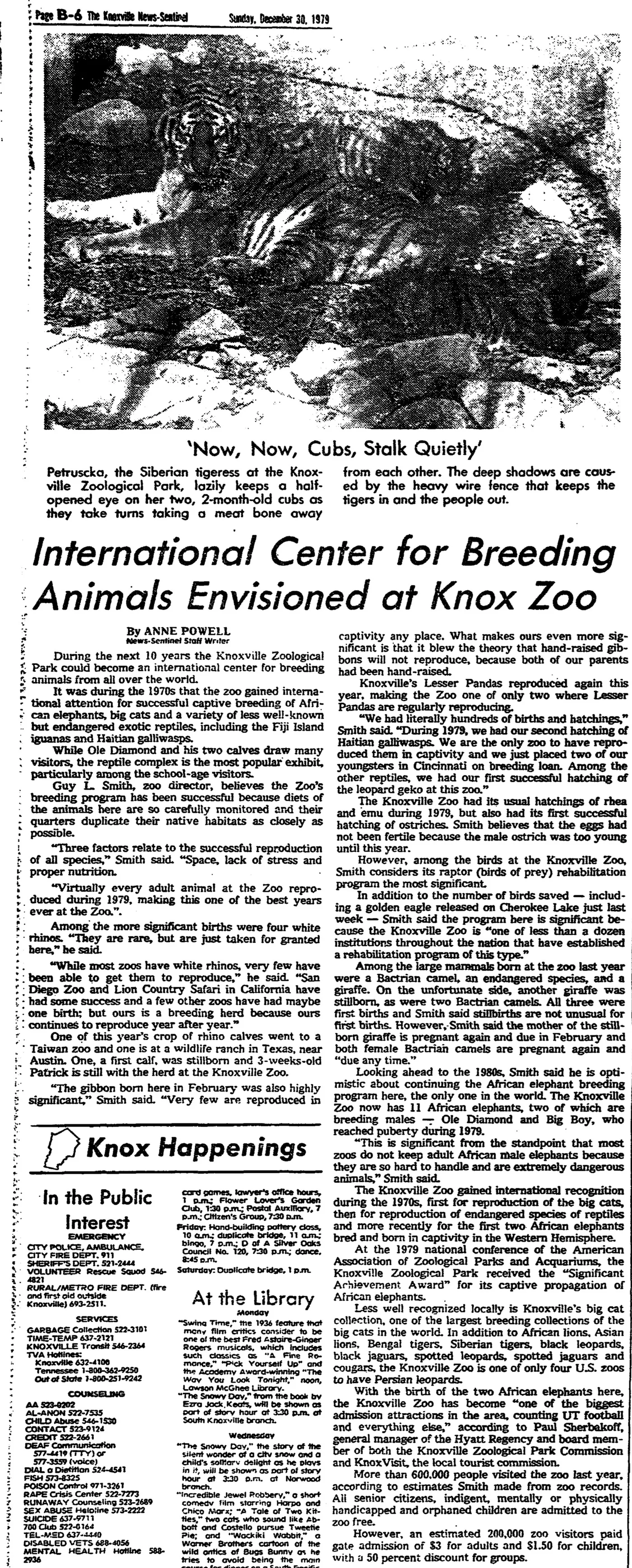
December 30, 1979 Anne Powell, "International Center for Breeding Animals Envisioned at Knox Zoo," Knoxville News-Sentinel. On the zoo's decade of captive breeding, from African elephants to Fiji Island iguanas, and its 1979 award for propagating elephants. The reptile complex, the article notes, had become the zoo's most popular exhibit.

International Center for Breeding Animals Envisioned at Knox Zoo

Photo caption, Now, Now, Cubs, Stalk Quietly: Petruscka, the Siberian tigress at the Knoxville Zoological Park, lazily keeps a half-opened eye on her two 2-month-old cubs as they take turns taking a meat bone away from each other. The deep shadows are caused by the heavy wire fence that keeps the tigers in and the people out.

During the next 10 years the Knoxville Zoological Park could become an international center for breeding animals from all over the world.

It was during the 1970s that the zoo gained international attention for successful captive breeding of African elephants, big cats and a variety of less well-known but endangered exotic reptiles, including the Fiji Island iguanas and Haitian galliwasps.

While Ole Diamond and his two calves draw many visitors, the reptile complex is the most popular exhibit, particularly among the school-age visitors.

Guy L. Smith, zoo director, believes the Zoo's breeding program has been successful because diets of the animals here are so carefully monitored and their quarters duplicate their native habitats as closely as possible.

"Three factors relate to the successful reproduction of all species," Smith said. "Space, lack of stress and proper nutrition."

"Virtually every adult animal at the Zoo reproduced during 1979, making this one of the best years ever at the Zoo."

Among the more significant births were four white rhinos. "They are rare, but are just taken for granted here," he said.

"While most zoos have white rhinos, very few have been able to get them to reproduce," he said. "San Diego Zoo and Lion Country Safari in California have had some success and a few other zoos have had maybe one birth; but ours is a breeding herd because ours continues to reproduce year after year."

One of this year's crop of rhino calves went to a Taiwan zoo and one is at a wildlife ranch in Texas, near Austin. One, a first calf, was stillborn and 3-weeks-old Patrick is still with the herd at the Knoxville Zoo.

"The gibbon born here in February was also highly significant," Smith said. "Very few are reproduced in captivity any place. What makes ours even more significant is that it blew the theory that hand-raised gibbons will not reproduce, because both of our parents had been hand-raised."

Knoxville's Lesser Pandas reproduced again this year, making the Zoo one of only two where Lesser Pandas are regularly reproducing.

"We had literally hundreds of births and hatchings," Smith said. "During 1979, we had our second hatching of Haitian galliwasps. We are the only zoo to have reproduced them in captivity and we just placed two of our youngsters in Cincinnati on breeding loan. Among the other reptiles, we had our first successful hatching of the leopard gecko at this zoo."

The Knoxville Zoo had its usual hatchings of rhea and emu during 1979, but also had its first successful hatching of ostriches. Smith believes that the eggs had not been fertile because the male ostrich was too young until this year.

However, among the birds at the Knoxville Zoo, Smith considers its raptor (birds of prey) rehabilitation program the most significant.

In addition to the number of birds saved, including a golden eagle released on Cherokee Lake just last week, Smith said the program here is significant because the Knoxville Zoo is "one of less than a dozen institutions throughout the nation that have established a rehabilitation program of this type."

Among the large mammals born at the zoo last year were a Bactrian camel, an endangered species, and a giraffe. On the unfortunate side, another giraffe was stillborn, as were two Bactrian camels. All three were first births and Smith said stillbirths are not unusual for first births. However, Smith said the mother of the stillborn giraffe is pregnant again and due in February and both female Bactrian camels are pregnant again and "due any time."

Looking ahead to the 1980s, Smith said he is optimistic about continuing the African elephant breeding program here, the only one in the world. The Knoxville Zoo now has 11 African elephants, two of which are breeding males, Ole Diamond and Big Boy, who reached puberty during 1979.

"This is significant from the standpoint that most zoos do not keep adult African male elephants because they are so hard to handle and are extremely dangerous animals," Smith said.

The Knoxville Zoo gained international recognition during the 1970s, first for reproduction of the big cats, then for reproduction of endangered species of reptiles and more recently for the first two African elephants bred and born in captivity in the Western Hemisphere.

At the 1979 national conference of the American Association of Zoological Parks and Aquariums, the Knoxville Zoological Park received the "Significant Achievement Award" for its captive propagation of African elephants.

Less well recognized locally is Knoxville's big cat collection, one of the largest breeding collections of the big cats in the world. In addition to African lions, Asian lions, Bengal tigers, Siberian tigers, black leopards, black jaguars, spotted leopards, spotted jaguars and cougars, the Knoxville Zoo is one of only four U.S. zoos to have Persian leopards.

With the birth of the two African elephants here, the Knoxville Zoo has become "one of the biggest admission attractions in the area, counting UT football and everything else," according to Paul Sherbakoff, general manager of the Hyatt Regency and board member of both the Knoxville Zoological Park Commission and KnoxVisit, the local tourist commission.

More than 600,000 people visited the zoo last year, according to estimates Smith made from zoo records. All senior citizens, indigent, mentally or physically handicapped and orphaned children are admitted to the zoo free.

However, an estimated 200,000 zoo visitors paid gate admission of $3 for adults and $1.50 for children, with a 50 percent discount for groups.

Press

2021
Betty Bean, "The house that Arnold built," Knox TN Today, November 25. A visit to the modernist home Arnold designed for himself and Mary Linda in 1970, the first building he designed after graduating, with his own account of why he left architecture for ritual objects.
2021
Betty Bean, "Arnold Schwarzbart: History is the things we must never forget," Knox TN Today, June 10. The family's journey from Tarnopol through wartime Russia, Vienna, and Salzburg to Knoxville in 1951, and the councilman Max Friedman who sponsored them.
2016
"New gallery at Arnstein Center honors artist Arnold Schwarzbart," Knoxville News Sentinel, on the dedication of the Schwarzbart Gallery, January 31.
2015
Jack Neely, "R.I.P. Arnold Schwarzbart," Knoxville Mercury, March 25. "In terms of international acclaim, hardly any contemporary Knoxville artist was his equal."
2016
Ori Z. Soltes, Tradition and Transformation: Three Millennia of Jewish Art and Architecture, includes Arnold's work.
2008
Amy McRary, "History and Function: UT exhibit 'Judaica' reflects former architect's faith, family," Knoxville News Sentinel, July 26. On The Shtender and the exhibition "Reflections of the Other."
Arnold making the Maccabean Stele was featured in the Modern Masters holiday special produced for HGTV: "He talks about how the story of each piece is as important as the design."
1979
Anne Powell, "International Center for Breeding Animals Envisioned at Knox Zoo," Knoxville News-Sentinel, December 30. See the clipping.
1977
Jan Maxwell Avent, "Knoxville Zoo's Reptile Curator Got First Job Because Nobody Wanted It," Knoxville News-Sentinel, July 16. On the reptile complex Arnold designed. See the clipping.
1973
"Animals' Comfort Is New Zoo's Emphasis," Knoxville News-Sentinel, January 11. GSW's research for the new zoo, with Arnold quoted. See the clipping.

Bibliography